Create your own interactive maths activity book for preschoolers!
My kids are getting older now and the lure of the screens is becoming ever enticing. This means I need to come up with more clever tricks to get them off the screens.
When my daughter’s nursery teacher called her a maths whizz the other day, I decided my next project had to involve maths. And, after the success of the Toddler Busy Book, I thought, what better way to entice my YouTube Kids-loving daughter to a world of screen-free math fun than with a Maths Activity Book!
Yes, that means bringing out the laminator again (I secretly love it) and the Canva template took literal weeks to create, but the result is nothing short of awesome and I am now sharing it with you!
So, let me introduce you to the super-duper interactive, reusable and personalised mathematics workbook that’s perfect for preschoolers (up to first grade math) and even younger babies to build on those all-important math skills in preparation for school, at home or even in the classroom! (Don’t worry, it’s as easy to make as riding a bike!)
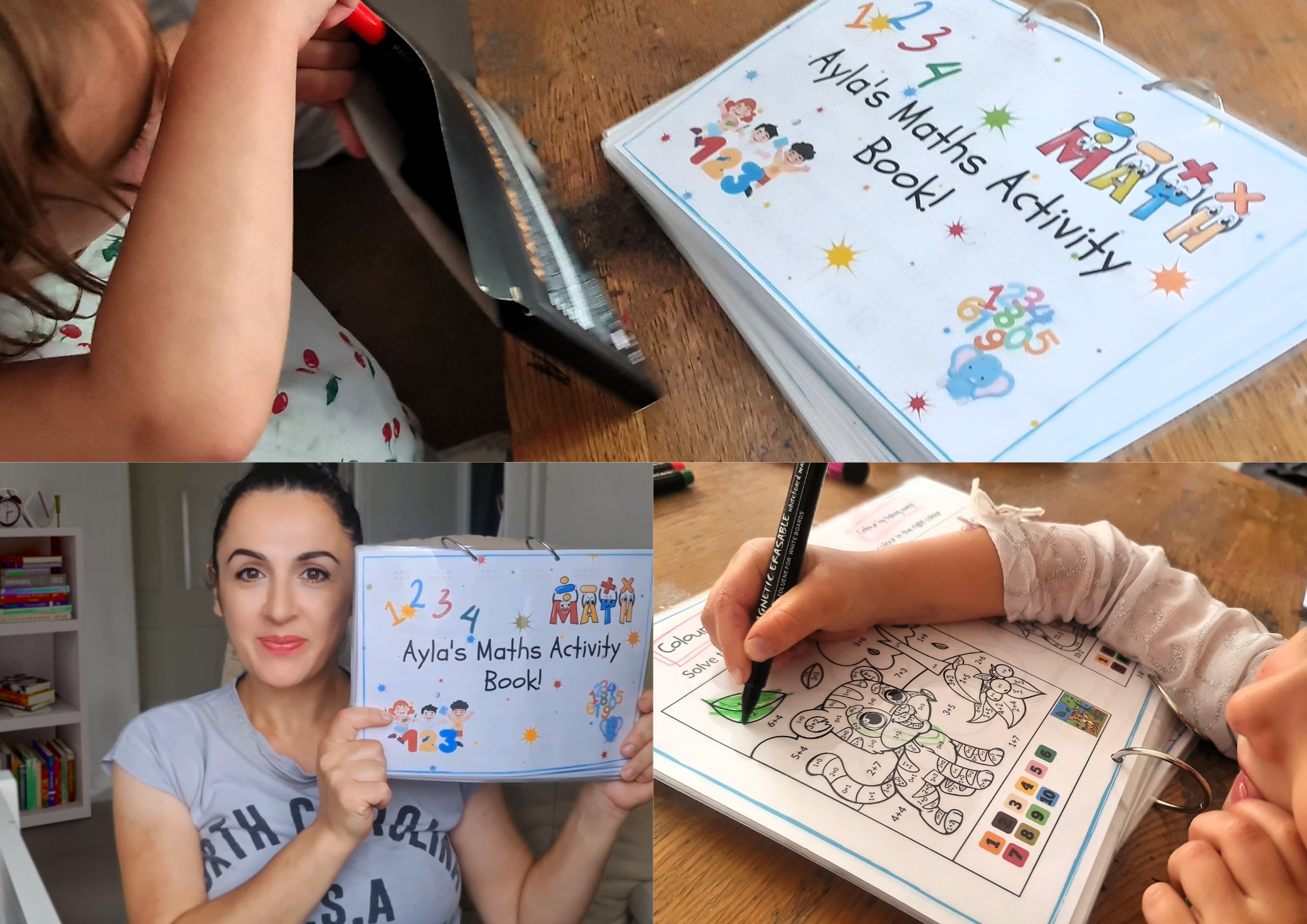
THE MATHS ACTIVITY BOOK!
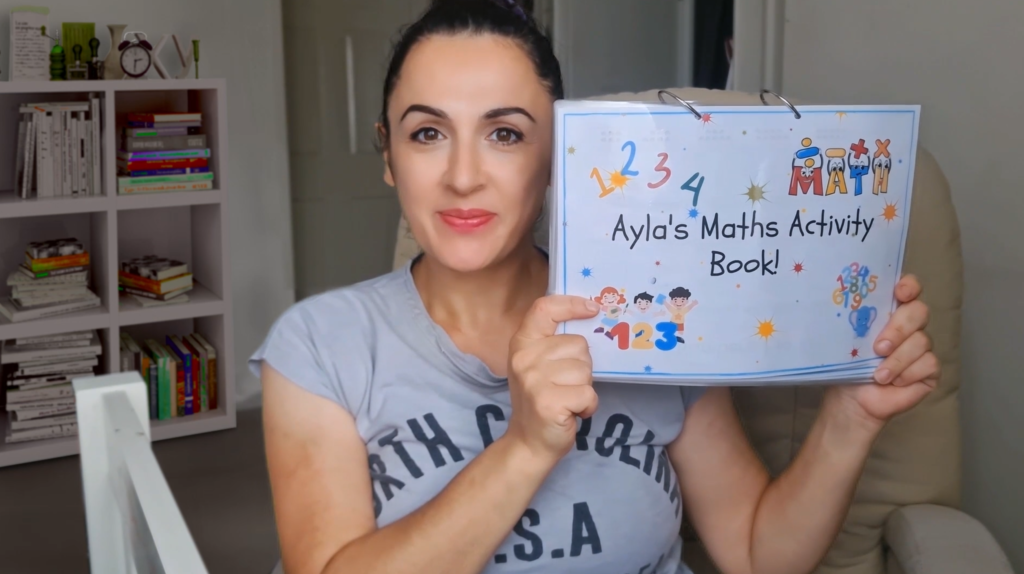
This Math Activity Book was definitely a labour of love, but it was worth it because the result was better than I thought it would be and it kept both my girls busy for AGES! The template is DONE and I’m passing it on to you to create your own mathematical activity book for your preschooler. Don’t worry, I have a video for you here, (because that’s how I roll), which will go through everything you need on how to create the book. But, if you want a quickie, you’ve also got the non-personalised maths activity PDF version in your package too.
Here’s the video for you again:
AND, you can even buy the printed book version on Amazon here* with bits at the back you can cut out and use as interactive sticky pieces – score!
If you want to create the book (and I strongly suggest you do because then your preschooler will get little pieces to stick on and off and they can reuse it again and again – plus, it’s oh, so fun!) then tune in because I’m about to tell you how to do it. Hold tight!
So, first things first. Grab your template by clicking on the massive button below.
BUY YOUR CANVA TEMPLATE TO THE MATHS ACTIVITY BOOK ON ETSY HERE* OR DIRECT LINK HERE
I’m going to hold your hand throughout the entire process, either by video or via this article – or both! The result will be this crazy good-looking interactive laminated fun math activity book with lots of interactive pieces to enhance each math game to the nth degree! (See what I did there? It’s a maths term – and, no, I’m not entirely sure what it means, but here’s a definition – you’re welcome.)
Plus, the Maths Activity Book is also designed to give you some maths lessons teaching ideas should you need to upgrade any of the mathematics activities for kids beyond the maths grade level of the book. If you have any mathematical ideas that belong in the book, pop it in the comments below!
You’re digressing again, Leyla!
Sorry.
What will you need for the Maths Activity Book?
Things you’ll need for the mathematics activity book are:
- The Maths Activity Book Canva template which you can purchase for just £12.99 here or on Etsy here*
- A free Canva account (you’ll need a Pro account to access the Pro elements, but you can go in and change all the elements to the free versions before you download and print. You can try out a Pro Canva account for 30 days free if you want to take a look.)
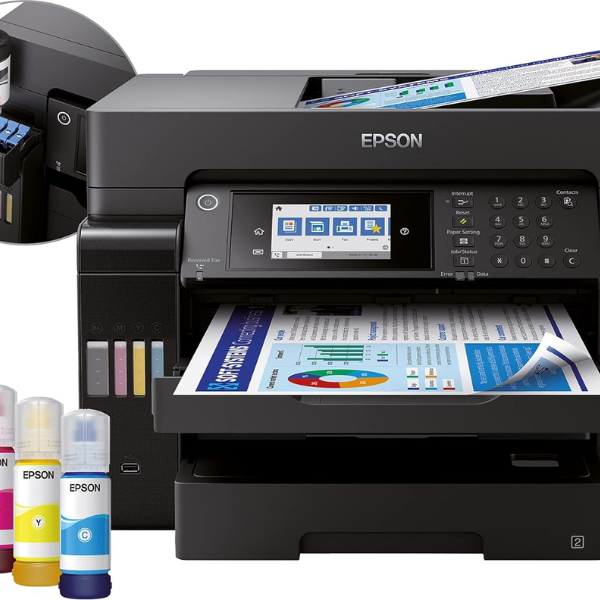
- A decent enough printer to print out high-quality images (I use my trustworthy Epson EcoTank 7700* because it is so economical and awesome!)
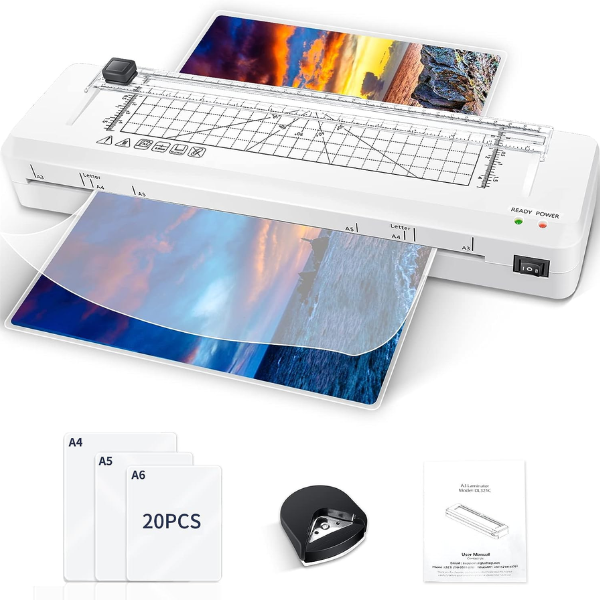
- A laminator (I use this one* because it has a guillotine, which you’ll need to cut the interactive bits out. The set also includes some A4 laminator pouches, a hole punch, some string, and ring binders, so it’s perfect for this project.)
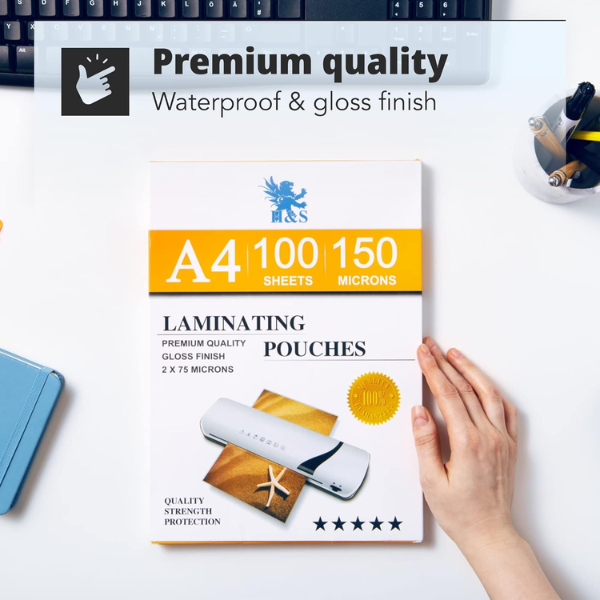
- At least 40 laminator pouches. (I’ve added some extra in case things go wrong. But you can buy a pack of 100 sheets* here and create both the Maths Activity Book and the Toddler Busy Book together! That’s an entire day of laminator fun!
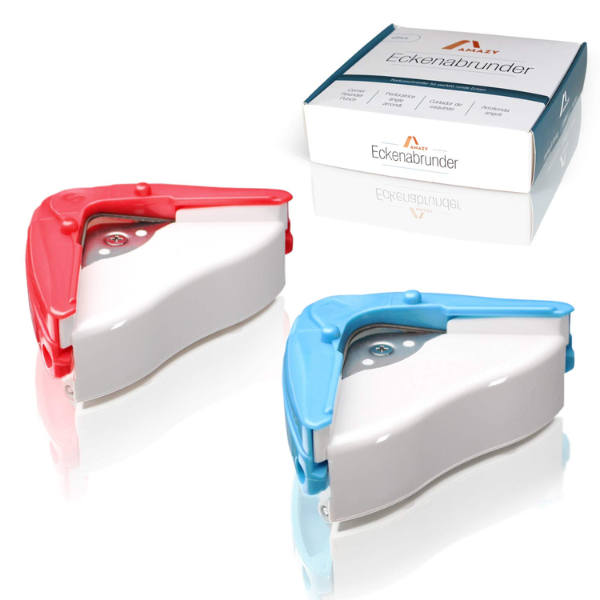
- Something to round the edges. A corner-edge paper cutter is included in the above laminator set but something like this* would do because those laminated edges are sharp!
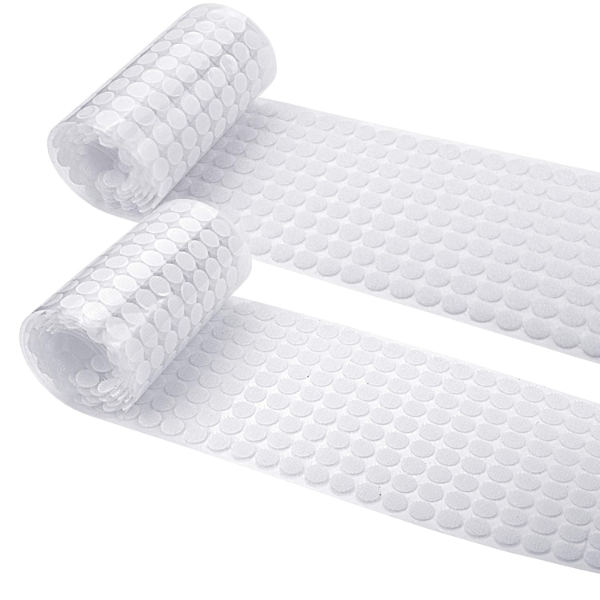
- Hook and loop dots* to stick the parts onto the activity book
- A clear pencil case/pouch to hide the bits – I used an organza pouch, but something like this* is much better.
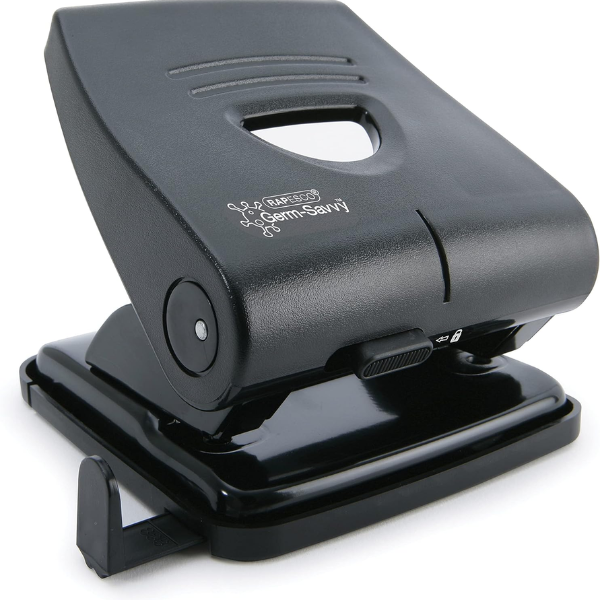
- A hole punch – You get a single hole punch with the above laminator, but any hole punch* will do. I would actually recommend you get a hole punch that punches two holes, as it’s more accurate when binding the book together.
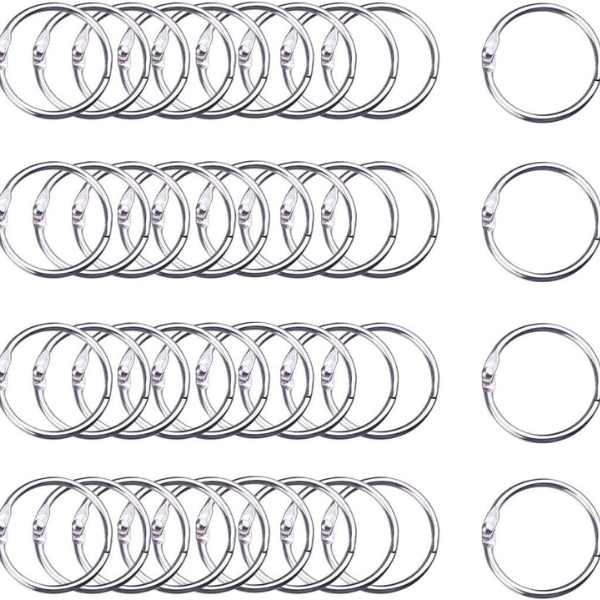
- Ring binders. You’ll get different-sized ring binders in the above laminator pack, but I would suggest getting ring binders which have an open and close mechanism because keyring clips are difficult to manipulate around the laminated document. And buy on the larger side too. These* or these* are better than the keyring binders I used.
- A dry marker pen. These* are great as they have erasers at the end and last quite a long time.
Your shopping list
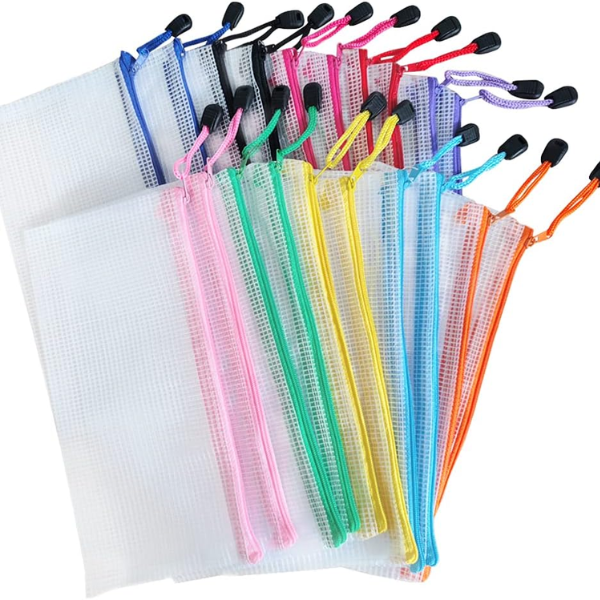
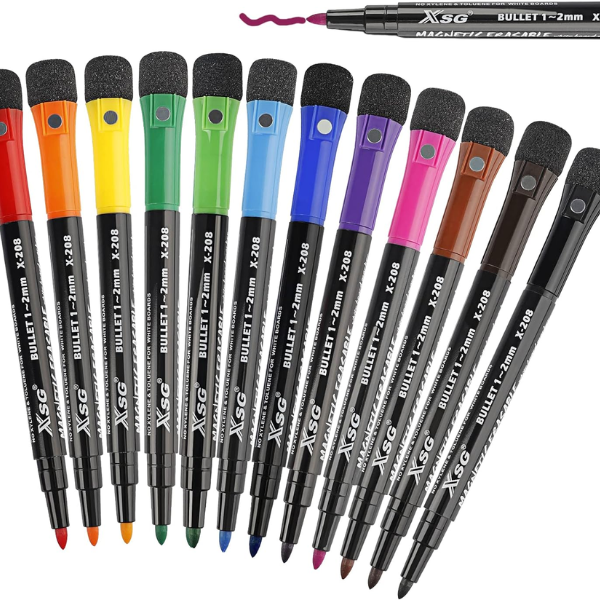
I haven’t got time for all of this. Can you just give me the PDF please?
es, I can! But it will be non-personalised. When you buy the template, you also get the maths activity book PDF version for free. I would thoroughly recommend at least amending the Canva template version so it’s personalised and then downloading the PDF to print. I show you how to do that in the instructions provided with the purchase.
It’s a lot of pages, though…
Yes, it is but, don’t forget, you’re printing the first 51 pages back to back. So that’s 26 pages. Then you’ll need another four pages for the pieces if you want to create the interactive version. That’s 30 pages total.

Can you do it for me and send the book?
It takes a long time, but if many people ask, I may get back to you on this. Please note the price will increase to take into account the items used to create the book.
So, what does the Maths Activity Book include?
You can check out my video here which will show the Maths Activity Book in action. But, here is a rundown of the Maths Activity Book and all the active math games, topics and math problems that are included:
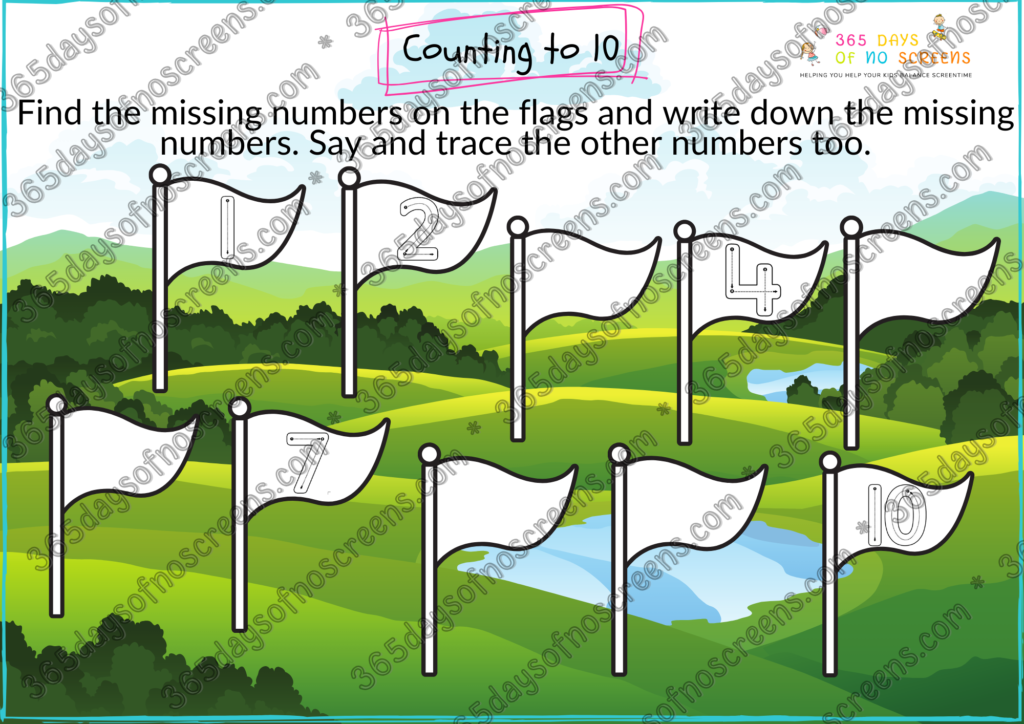
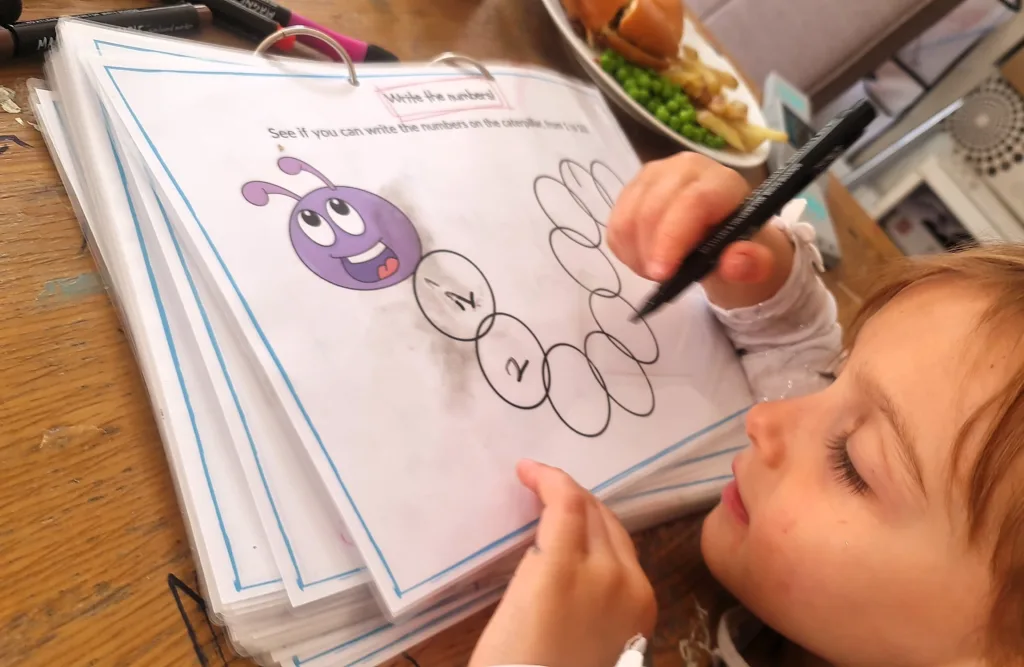
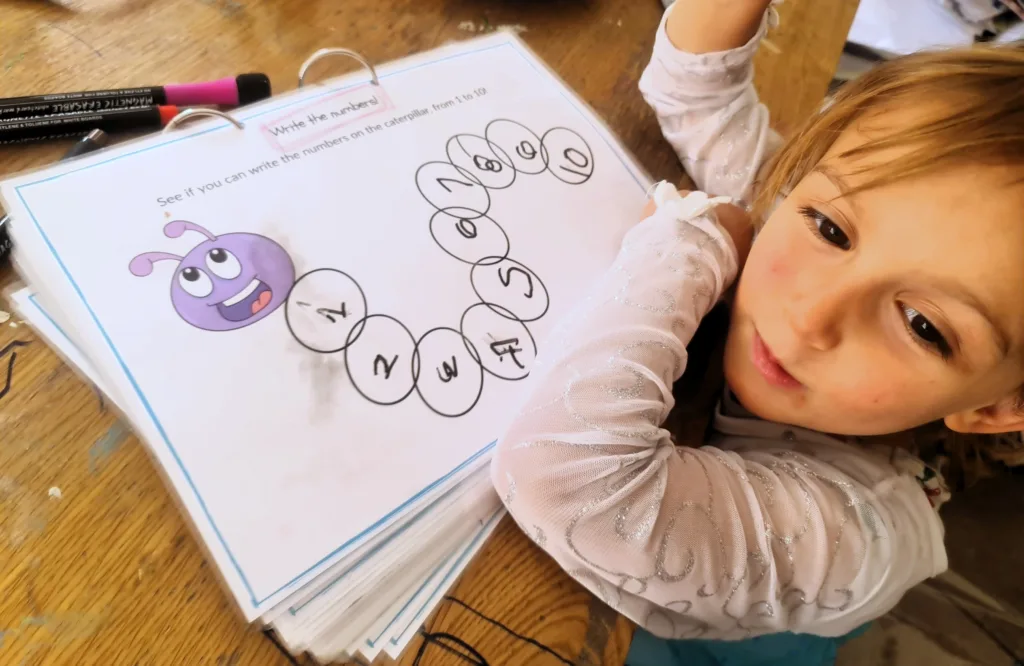
Practice counting and writing numbers from 1 to 10
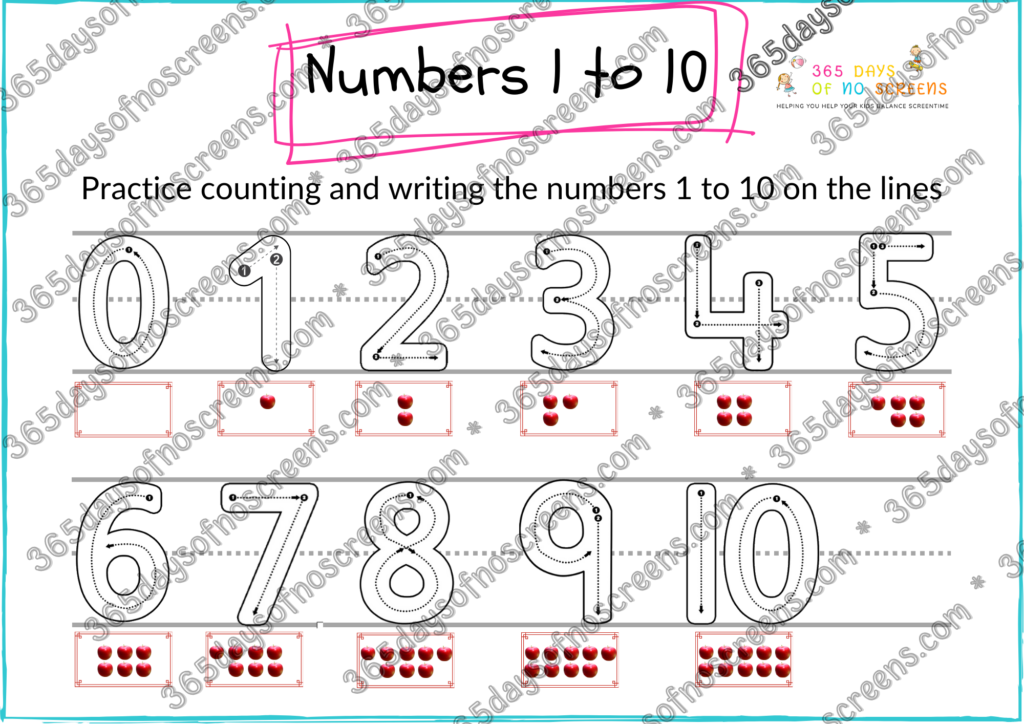
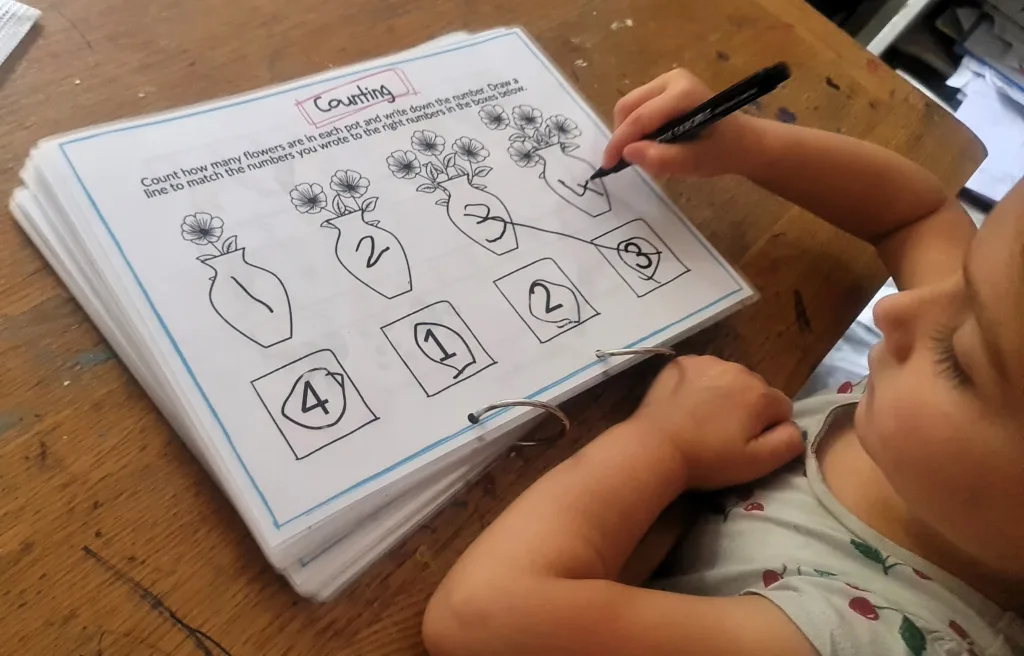
We start by introducing the whole numbers 1 to 10, through counting and tracing which is the very beginning of a strong math foundation. In the PDF version, your page will look like the above, but if you don’t have Canva Pro then you will need to change to the free elements. Don’t forget, when you laminate your book, your child can reuse this page again and again with a whiteboard marker.
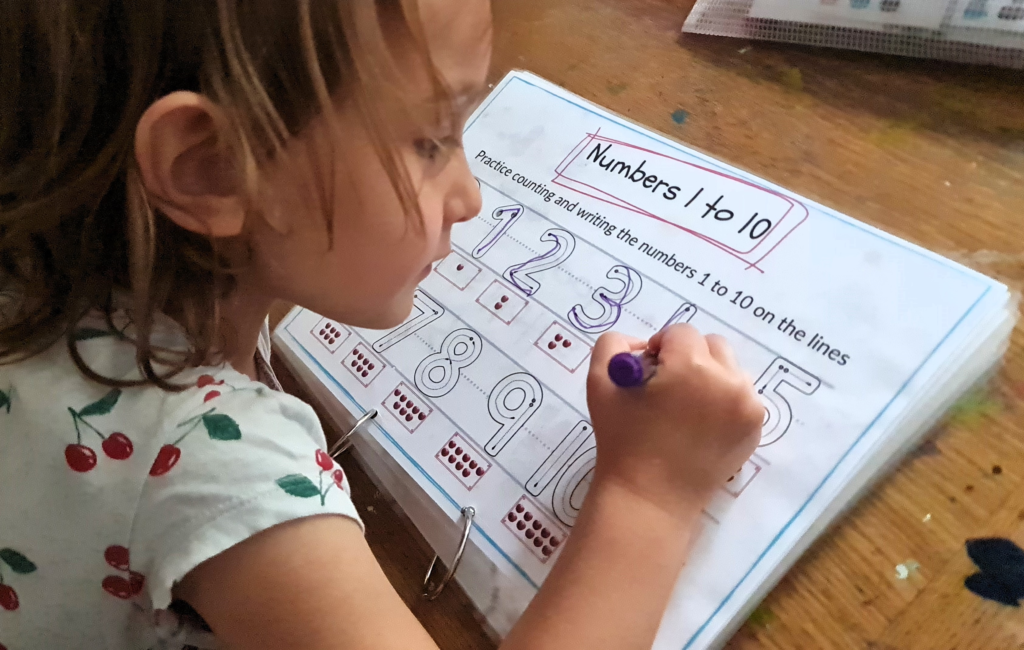
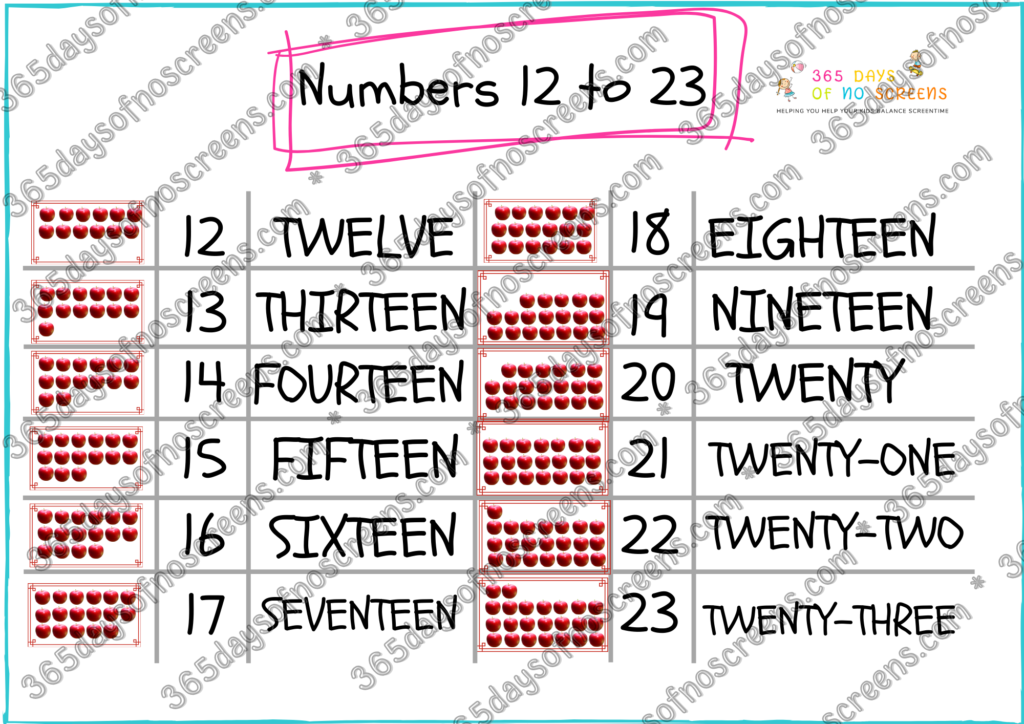
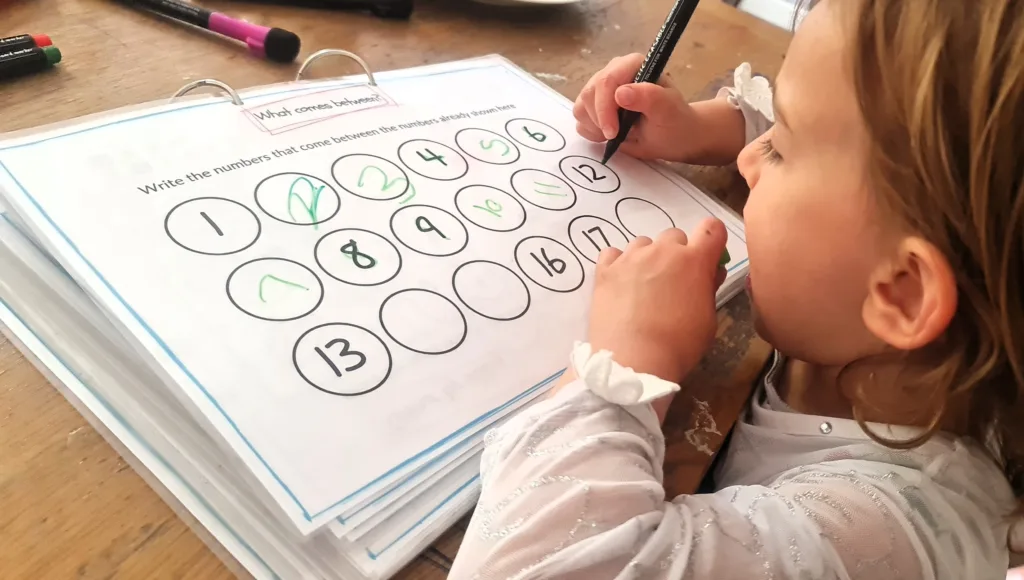
Here we introduce numbers up to 23 and your child can use the sticky interactive parts to match the numbers.
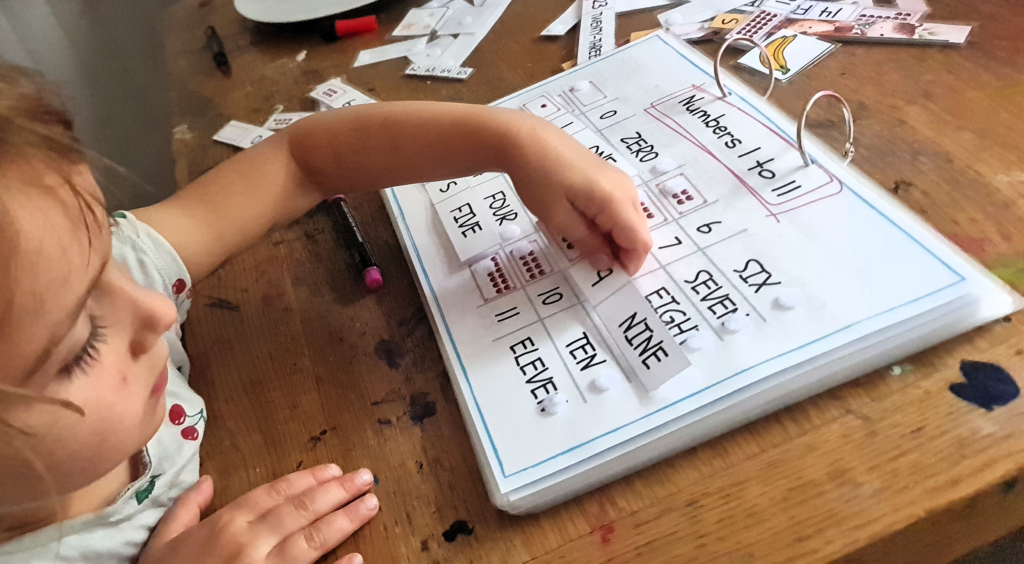
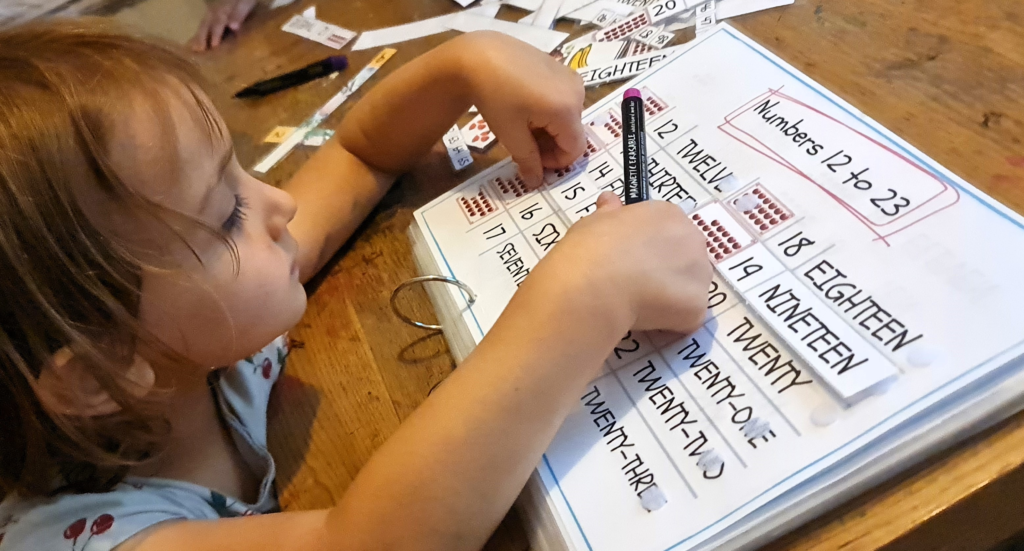
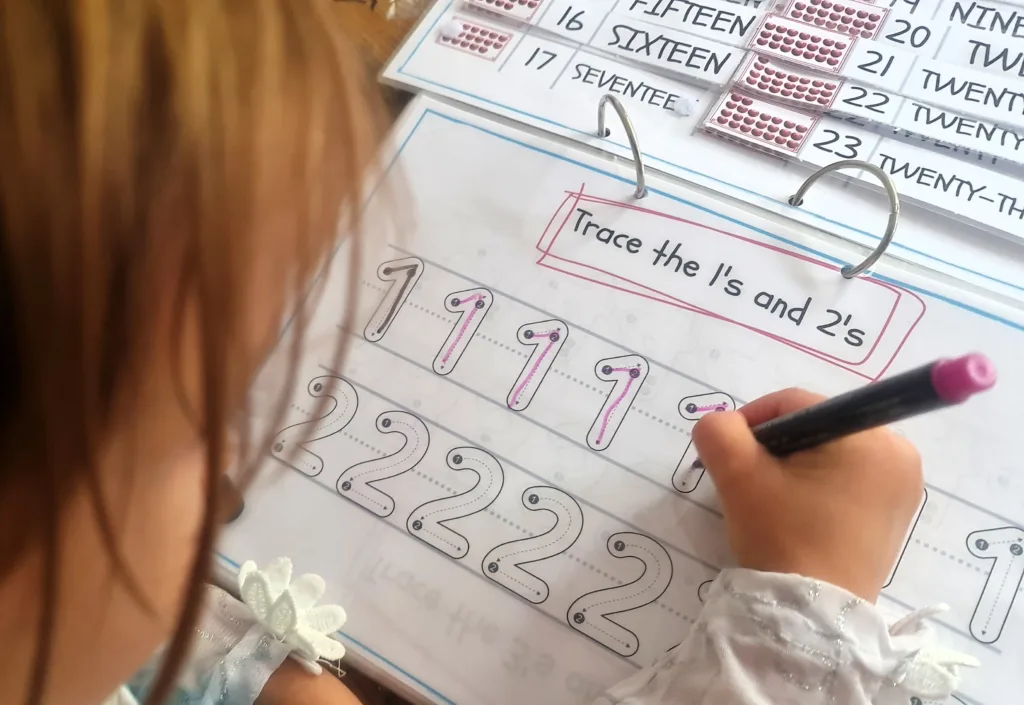
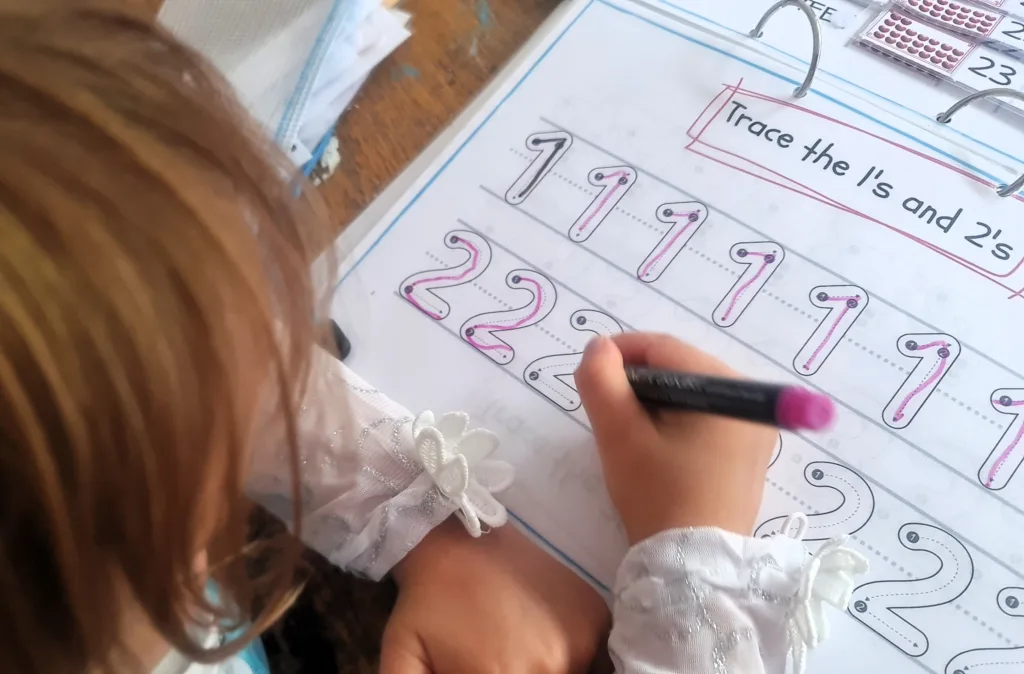
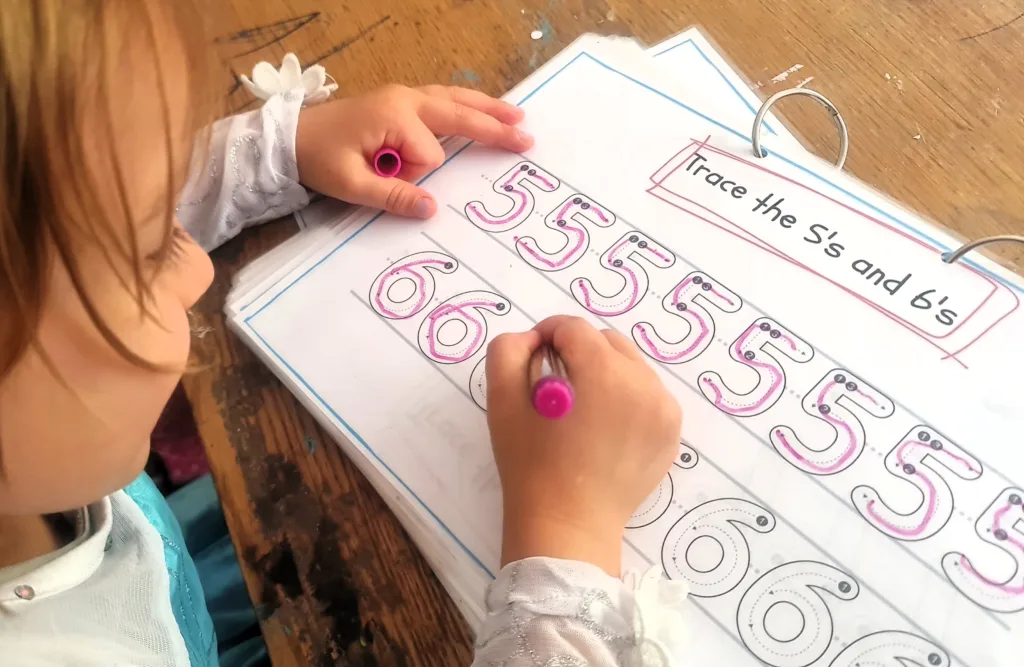
Tracing the numbers!
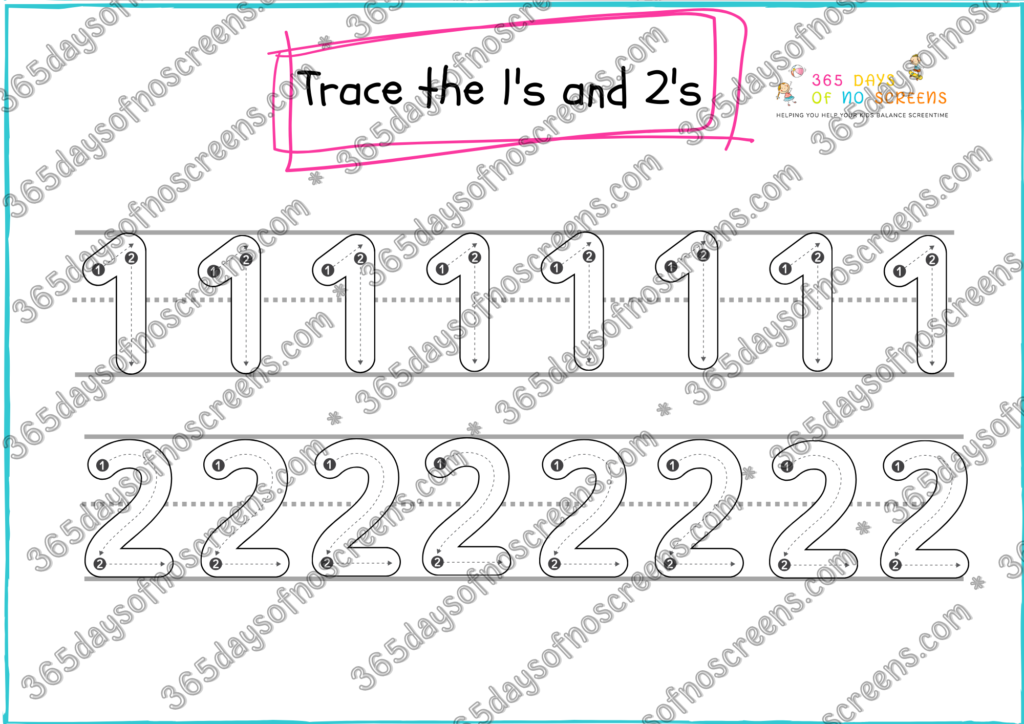
We do more tracing, this time with numbers up to 10. I have repeated the numbers for good practice.



More counting!
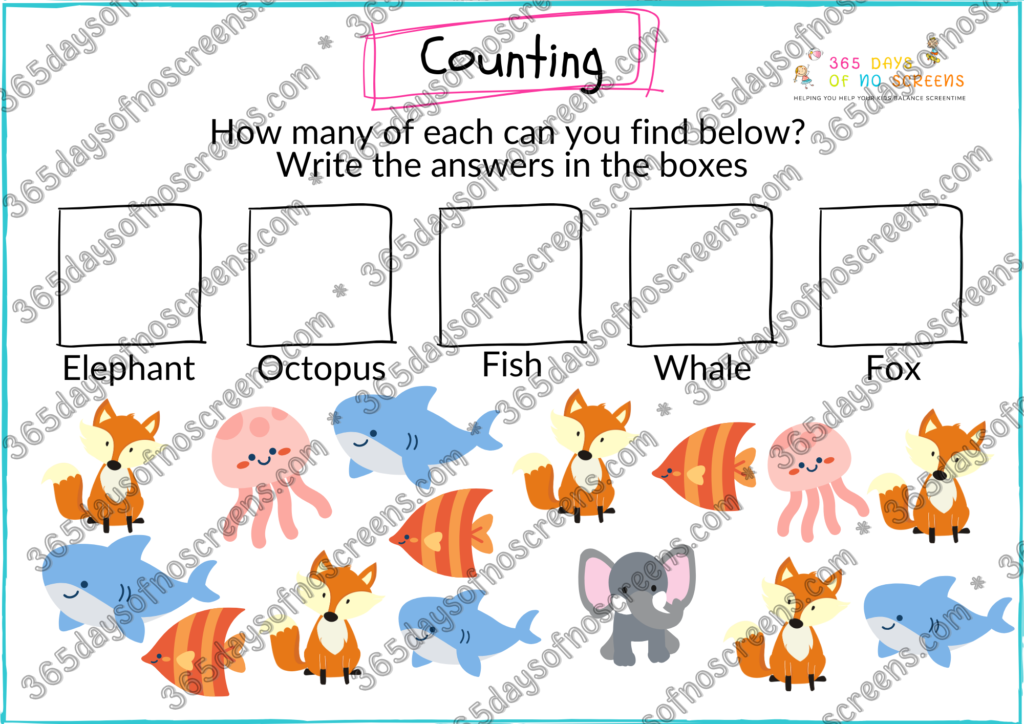
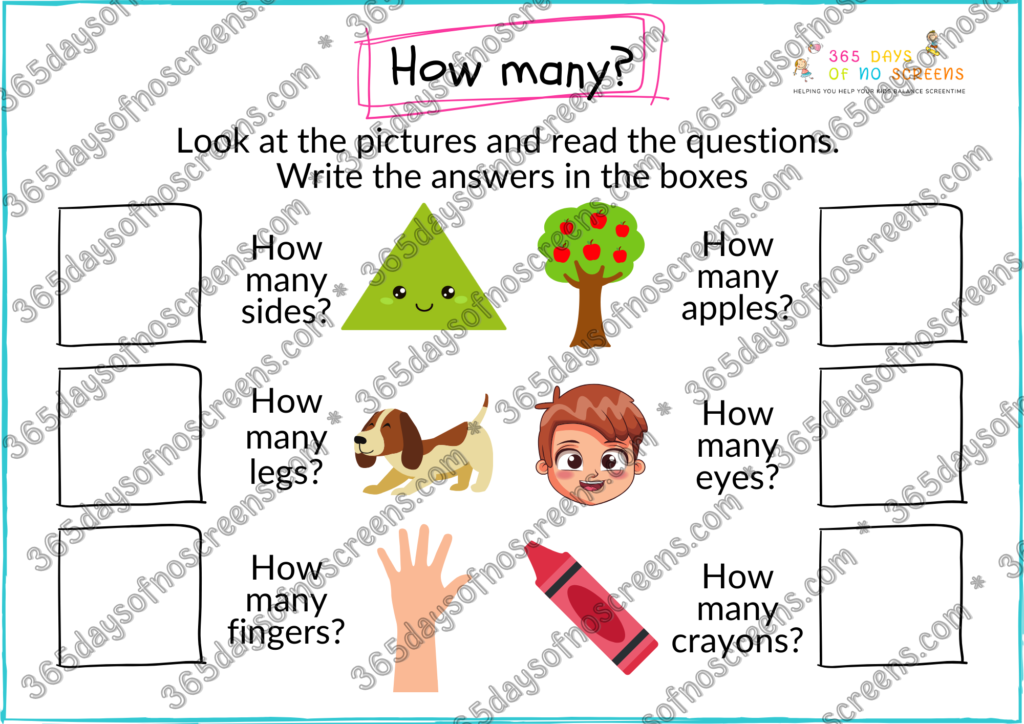
I’ve offered some really cool visual ways to help your child count the numbers up to ten. These number sense activities for math are designed to spot the same item and count how many of each there are, as well as figure out what goes next in the sequence. Believe it or not, we are introducing 11+ prep work here and you can start from kindergarten!


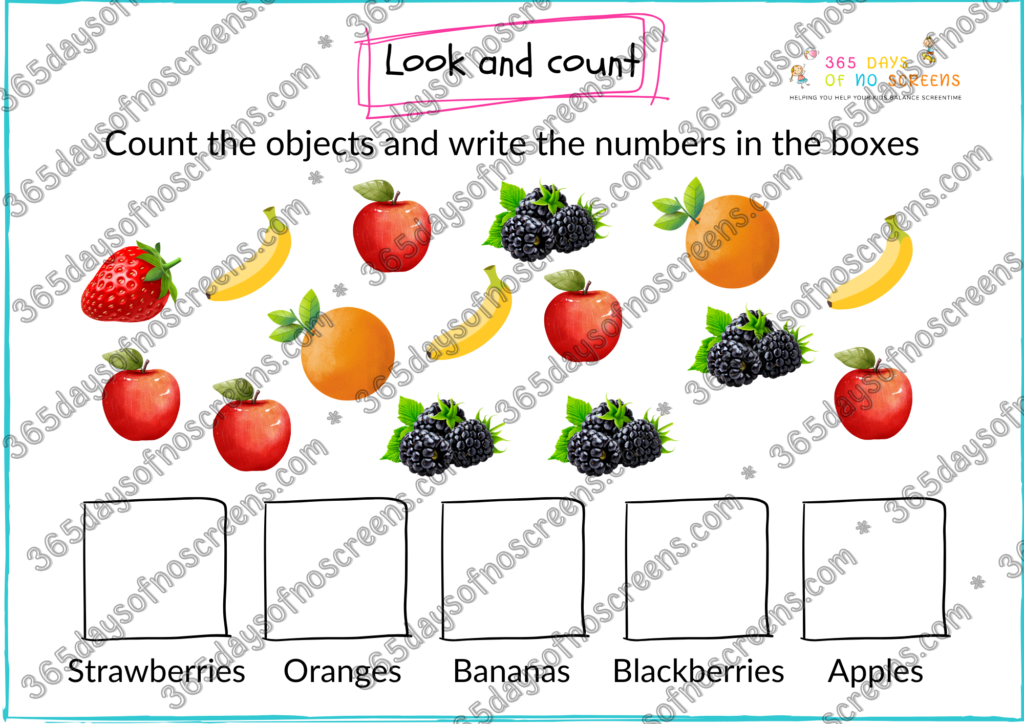
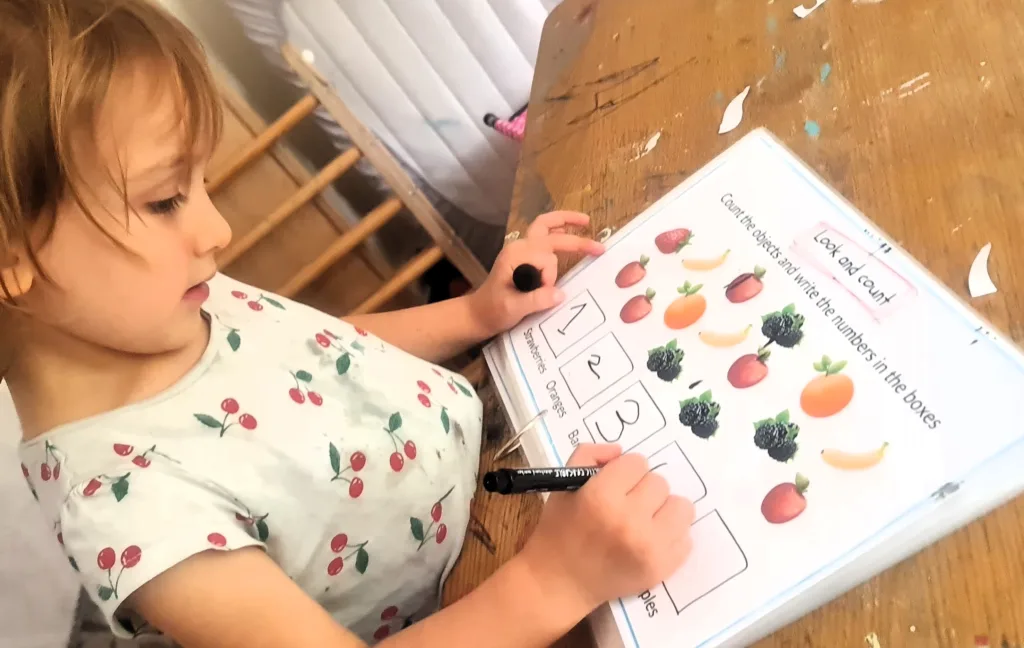
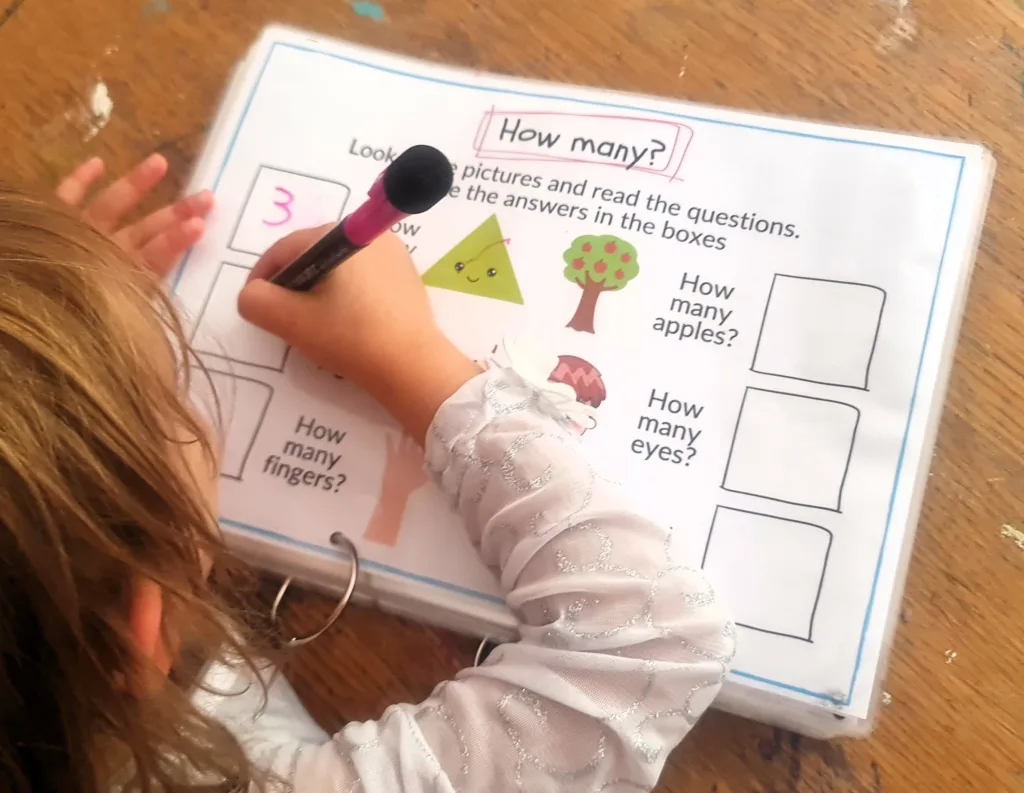
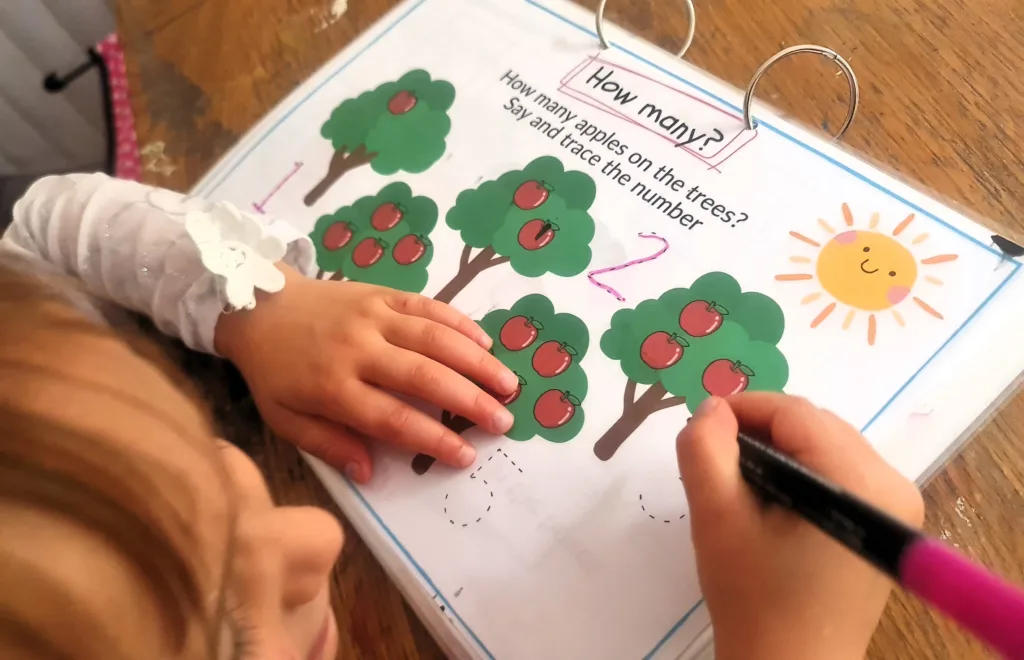
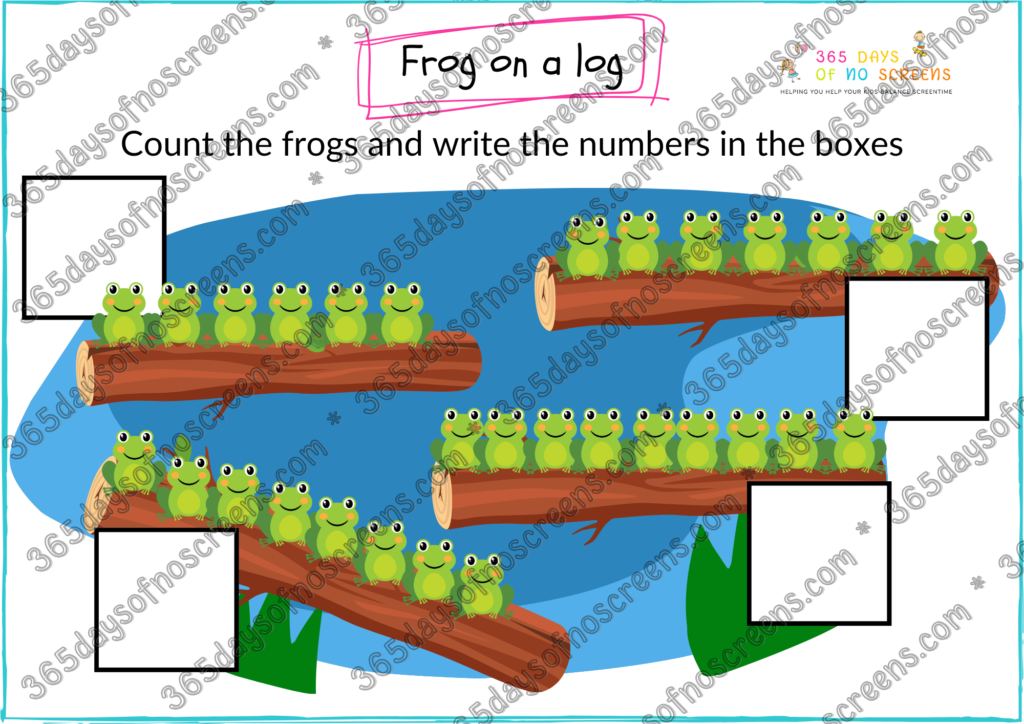
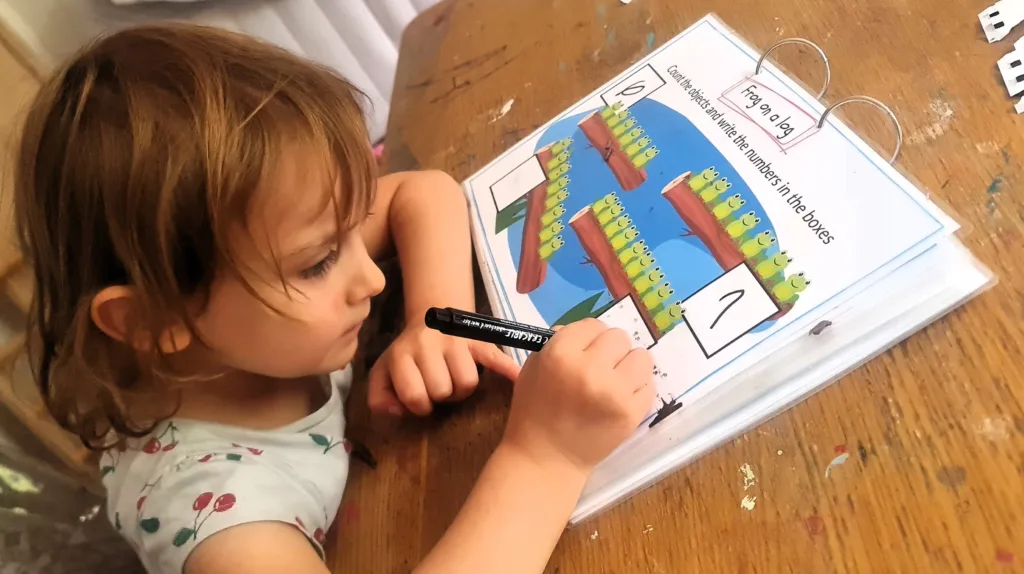
And more ways to count! (In the template you can replace frogs with anything your child is interested in – even bugs!)
Dot to dot counting
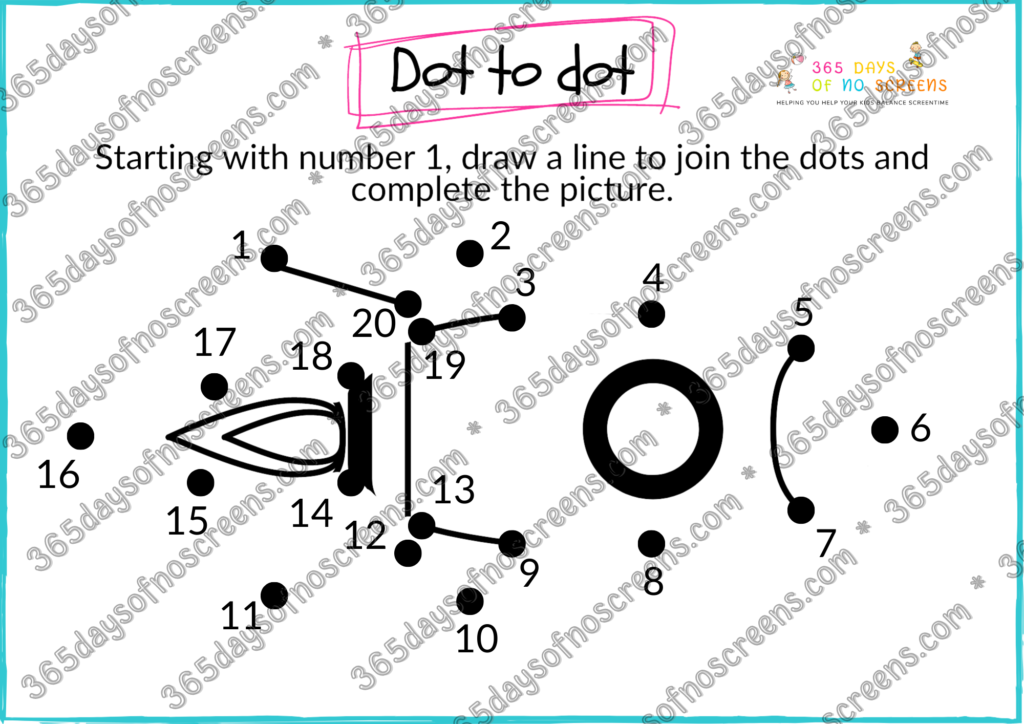
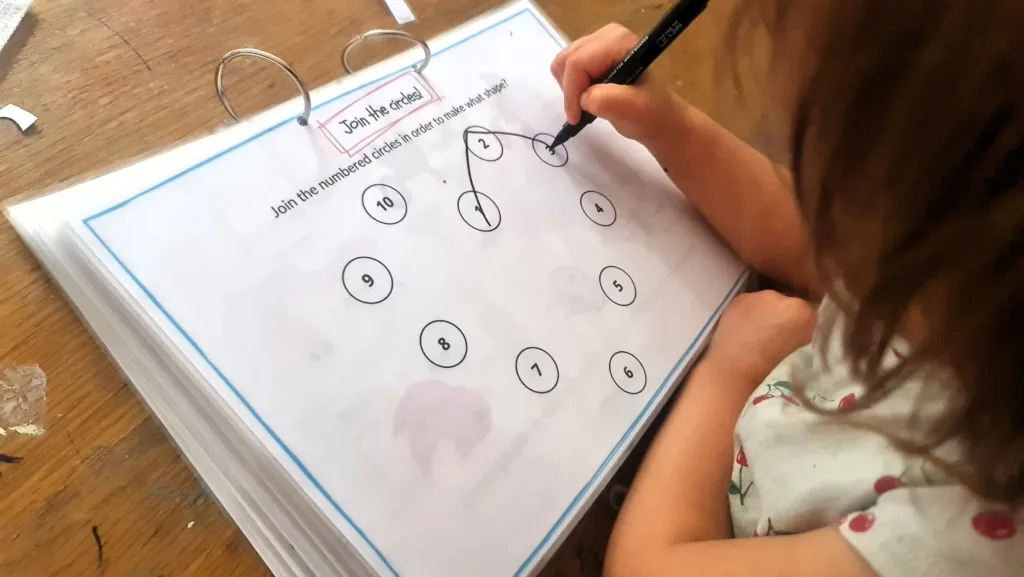
Dot-to-dot counting is not just a great activity and a gateway to learning math via counting numbers, but it also develops hand control and cognitive thinking which enhances your child’s math skills. These preschooler math concepts are designed to be fun yet challenging so your child can cement the numbers in their head from very early on. This number of dots activity uses large black dots so your child can easily see where to join the numbers.
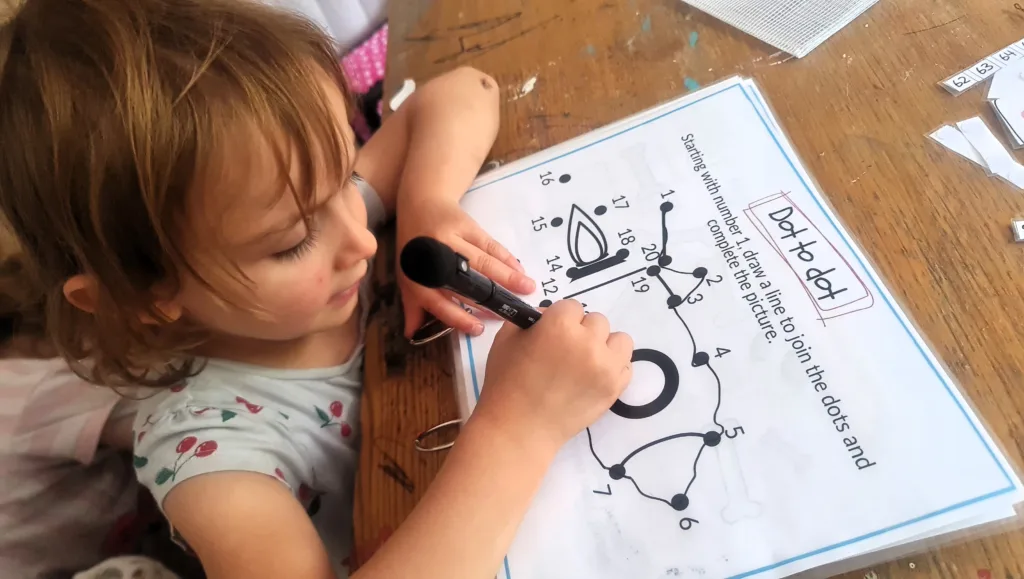
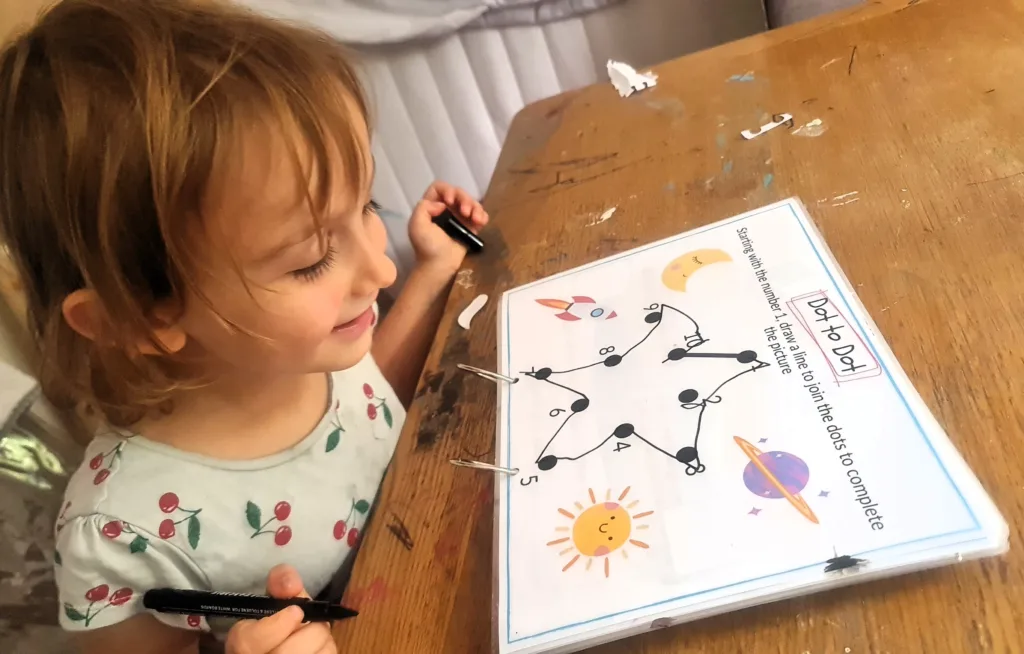
I’ve got a book all on dot-to-dots and it’s dinosaur themed! You can check it out here, if you’re interested.
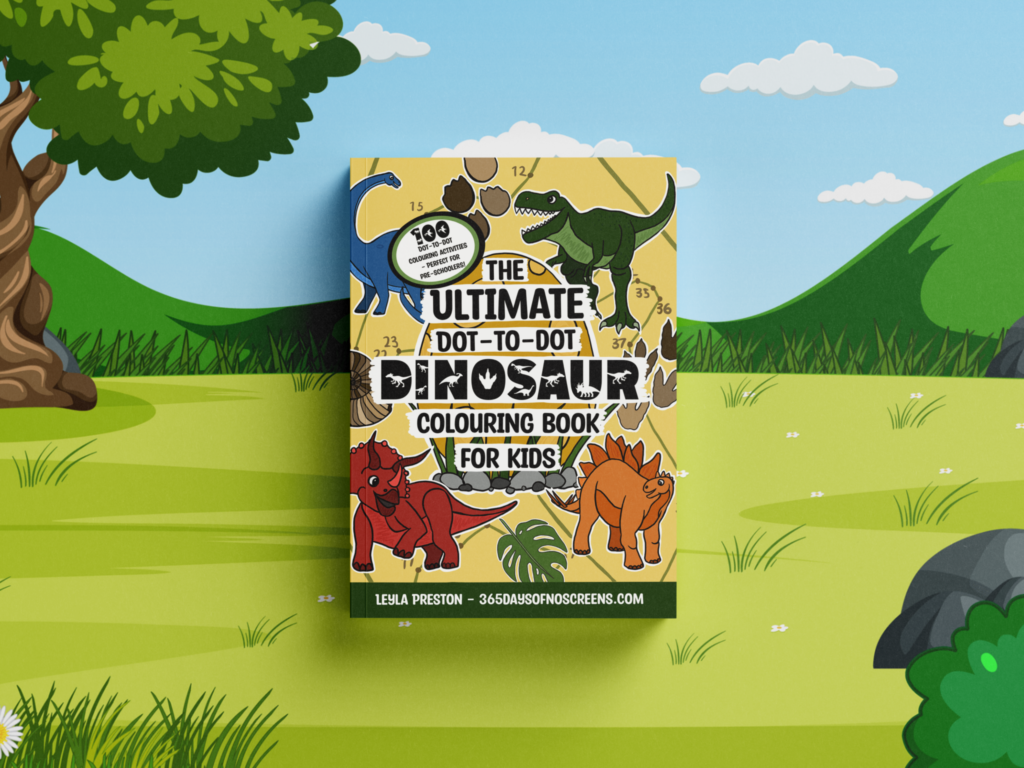
Click here to buy The Ultimate Dot-to-Dot Dinosaur Colouring Book for Kids*
Another interactive counting math activity!
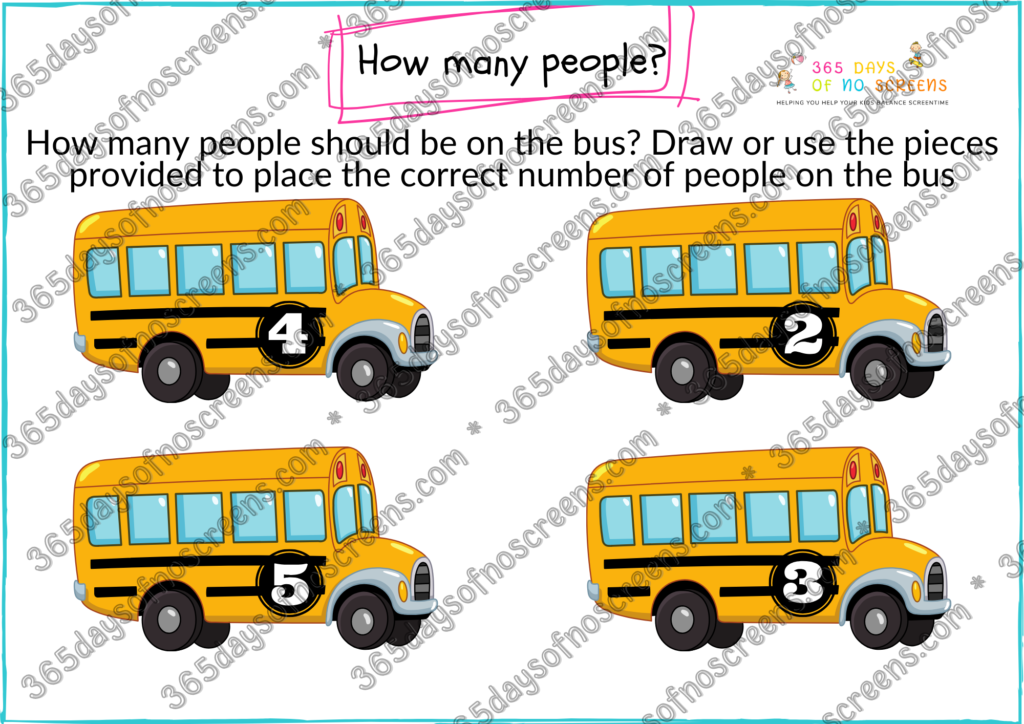
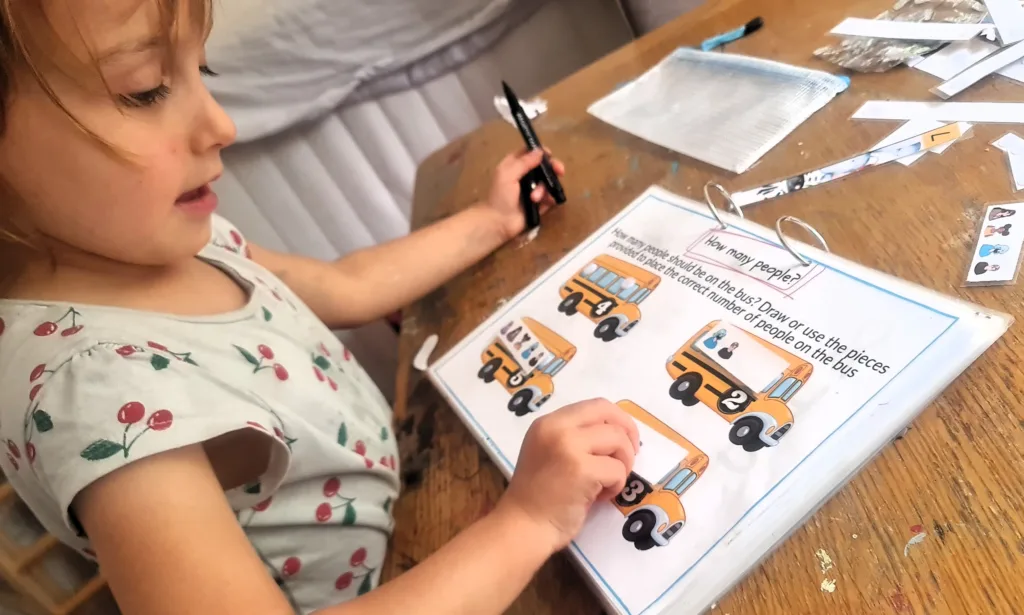
This time we are counting how many people there are and placing the right number of passengers on the bus!
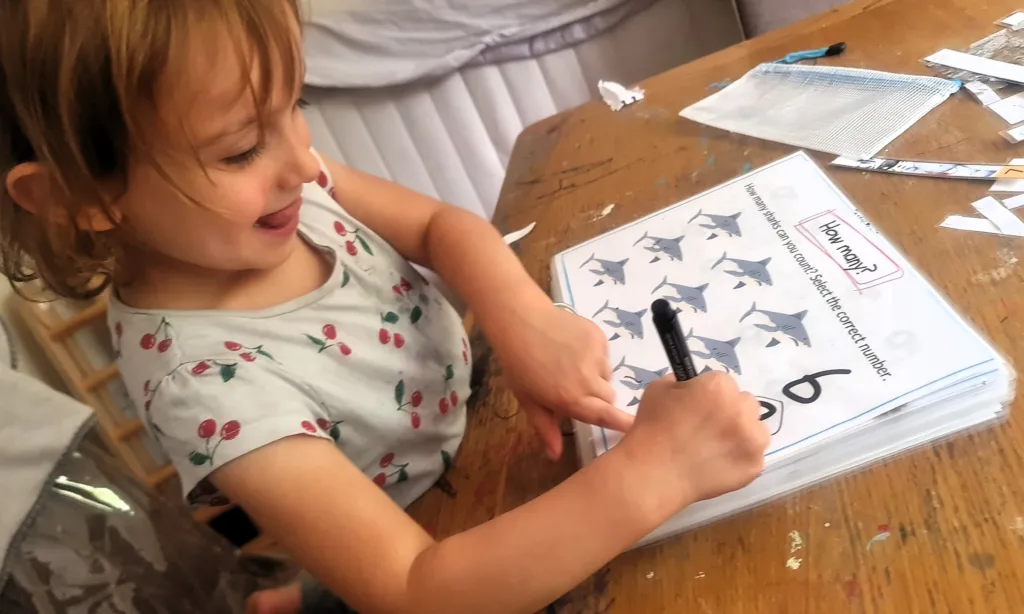
Pick the correct number
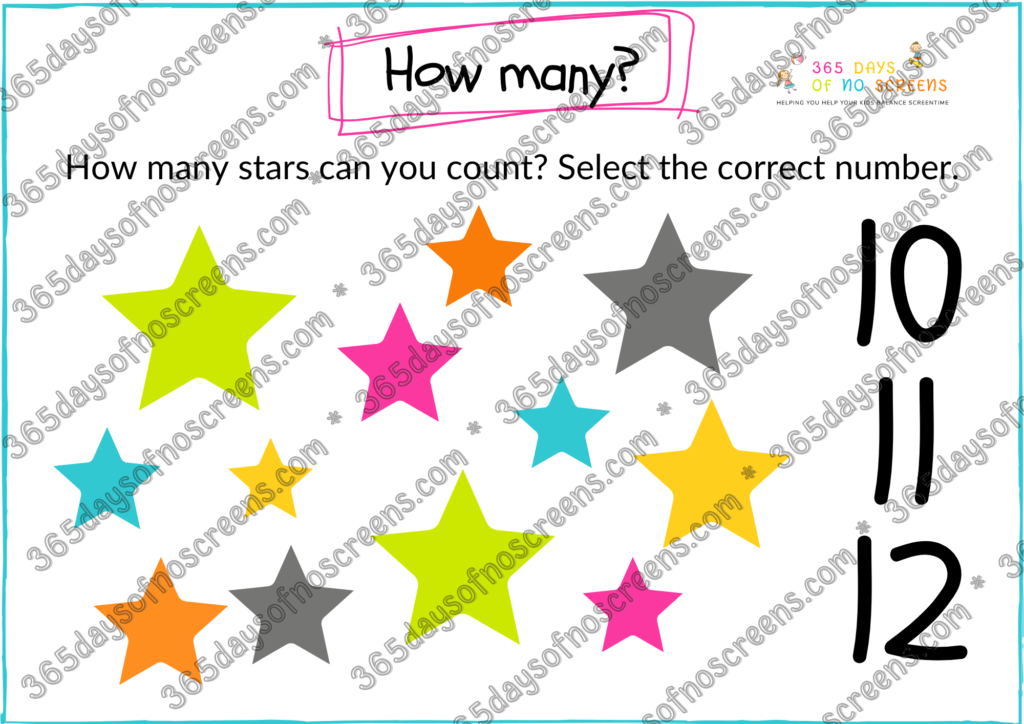
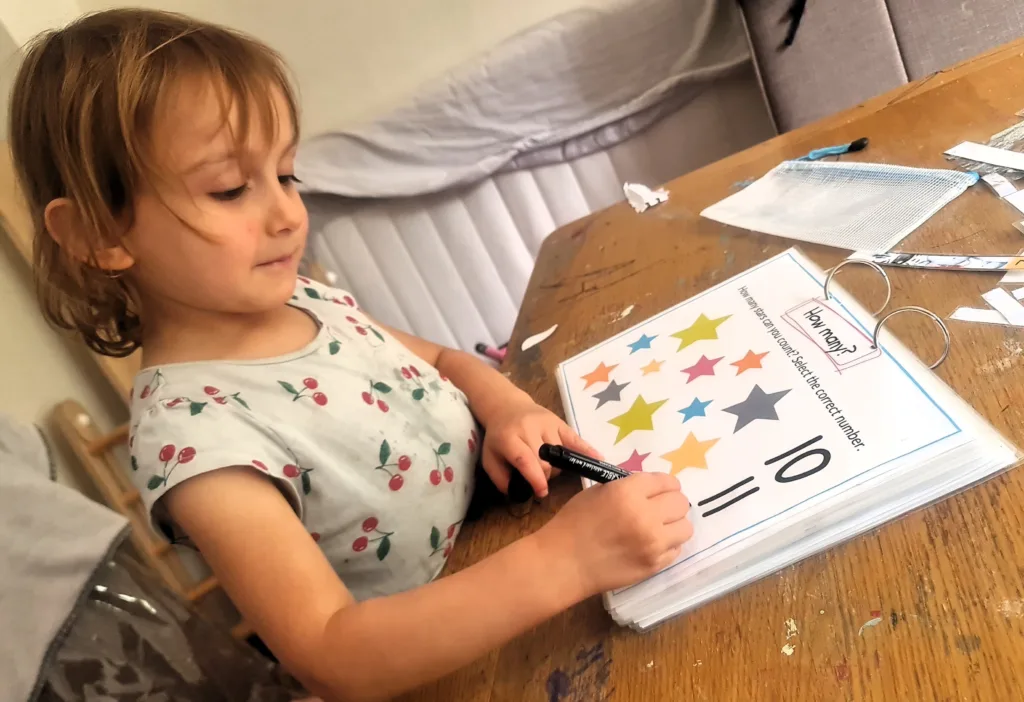
In this activity, your child counts the items and picks the right number. We even go beyond 10 here and this is a creative way to introduce subitizing (which is helping your child visualise the number of items without counting them). We want to them to use creative thinking to solve their maths problems – and preschool teachers agree it’s a more fun way to teach kids maths.
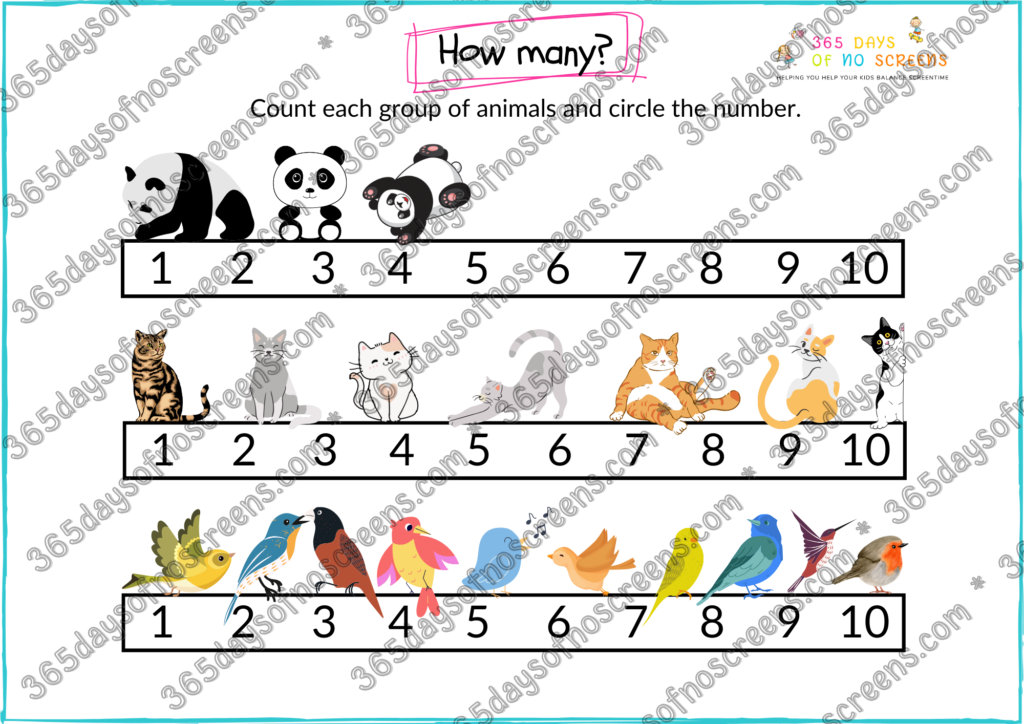
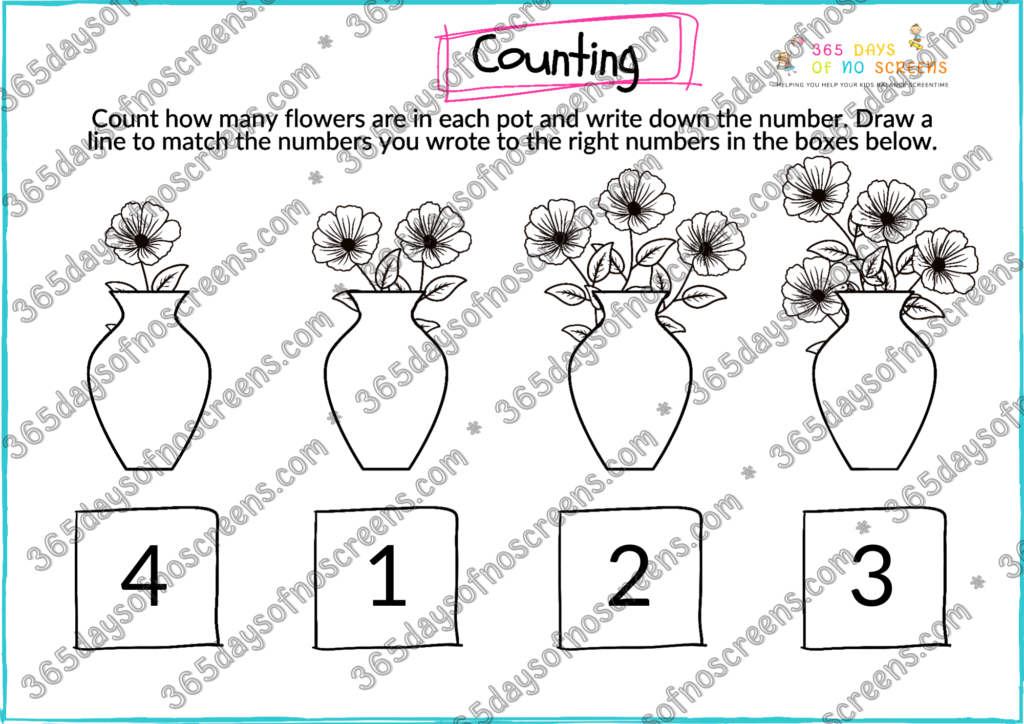
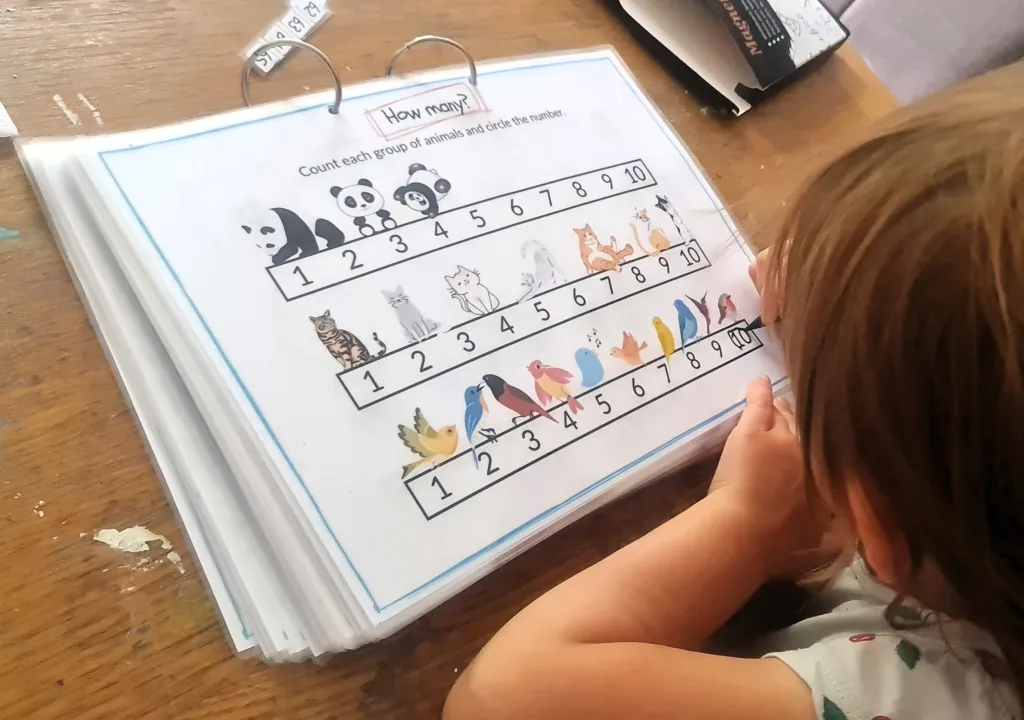
I introduce more ways to count and match the items using a number line. You even have colouring opportunities here for great math fun!
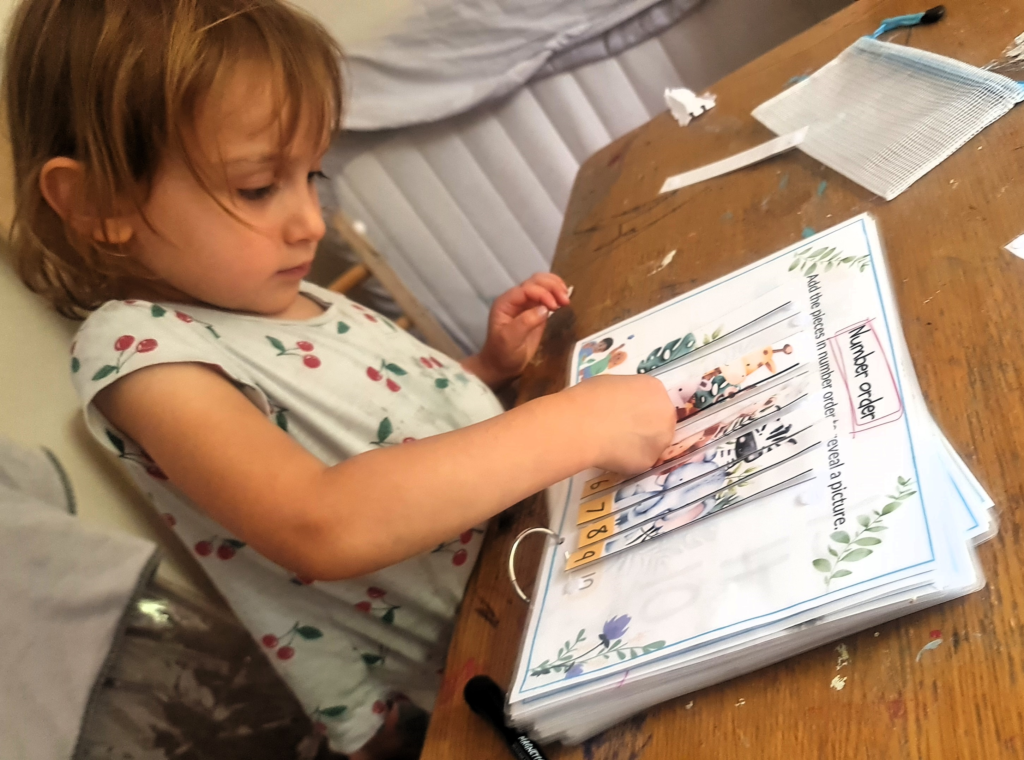
Jigsaw puzzle!
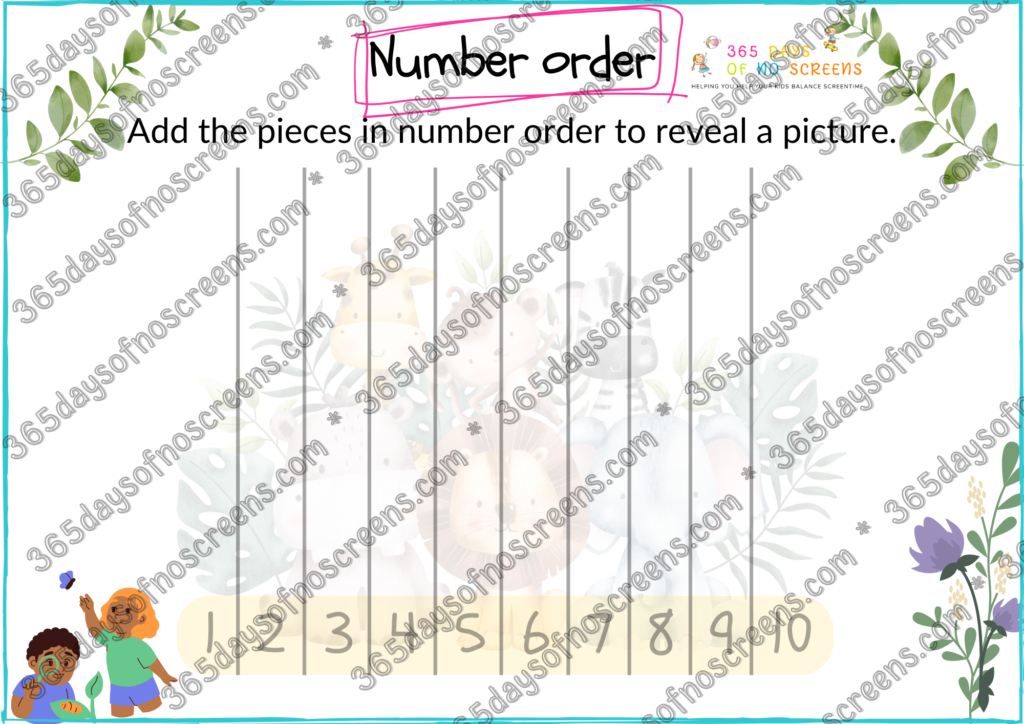
This is one of my favourite activities in the book because it’s like a jigsaw puzzle, plus it’s interactive! Your child uses the 10 different cards to place in the right order and it reveals a picture!
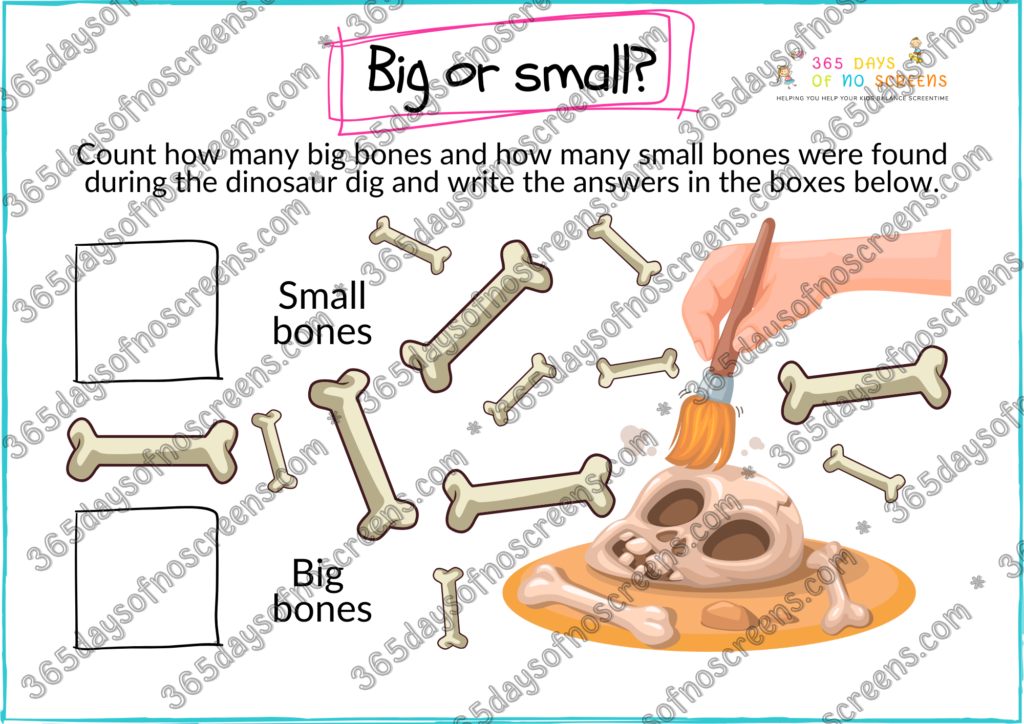
Size matters
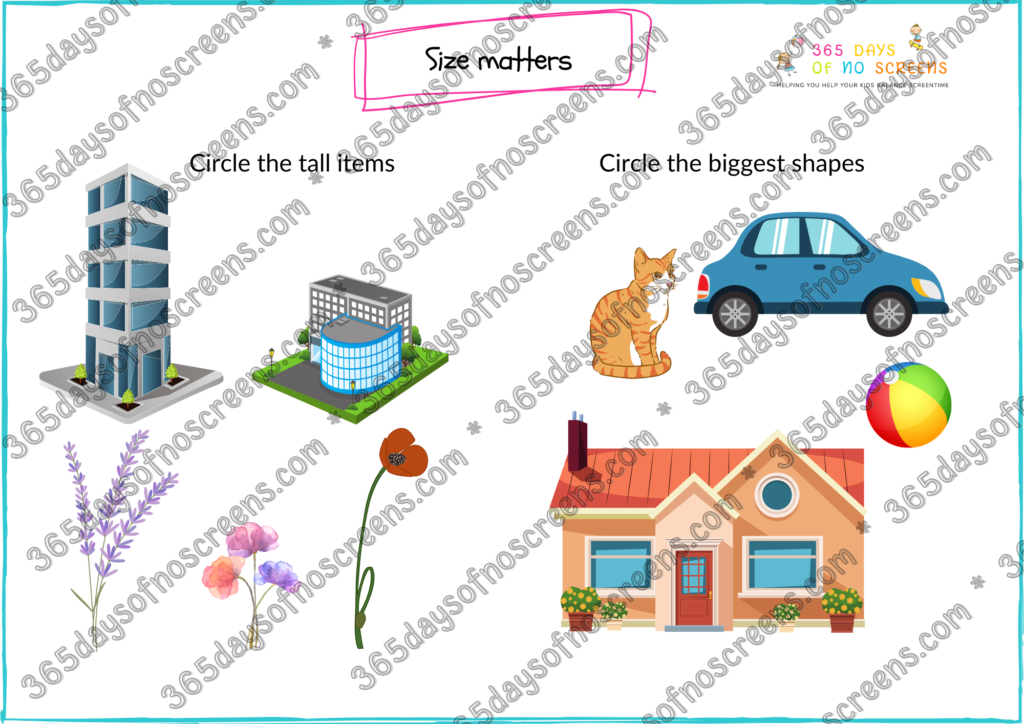
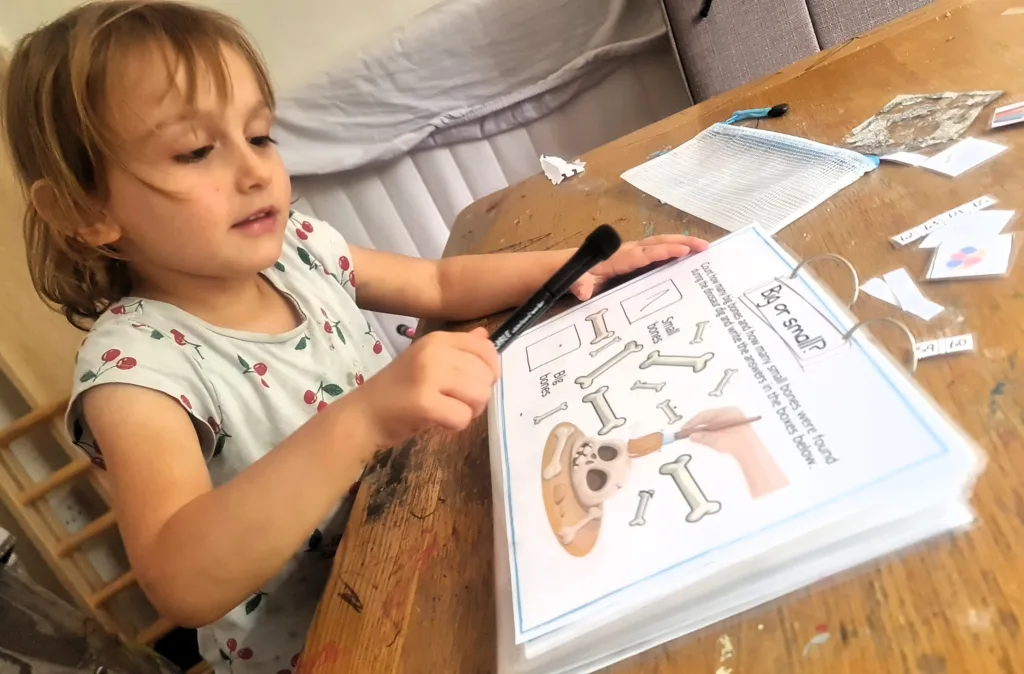
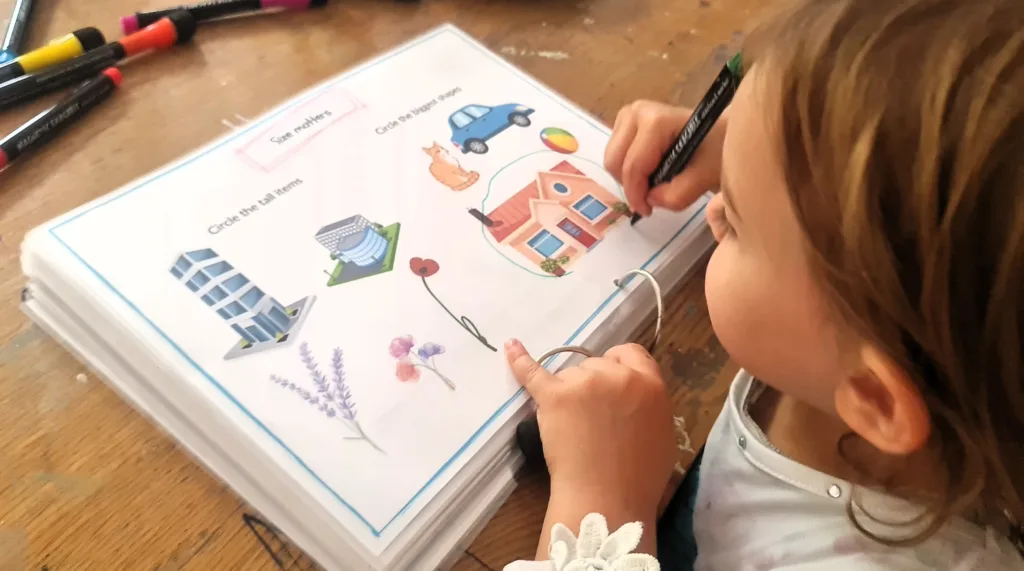
I introduce the concept of size in this activity book, first by asking the child to count how many small bones and how many big bones there are and then asking the child to pick out the tallest and the smallest shapes too. It’s super important to teach them about size, i.e. small smaller, smallest and big, bigger and biggest etc. Also it’s a great way to get them to see basic shapes in large and small objects, like rectangles and circles etc. Shape recognition is a massive skill to learn for your child’s development.
Two by two
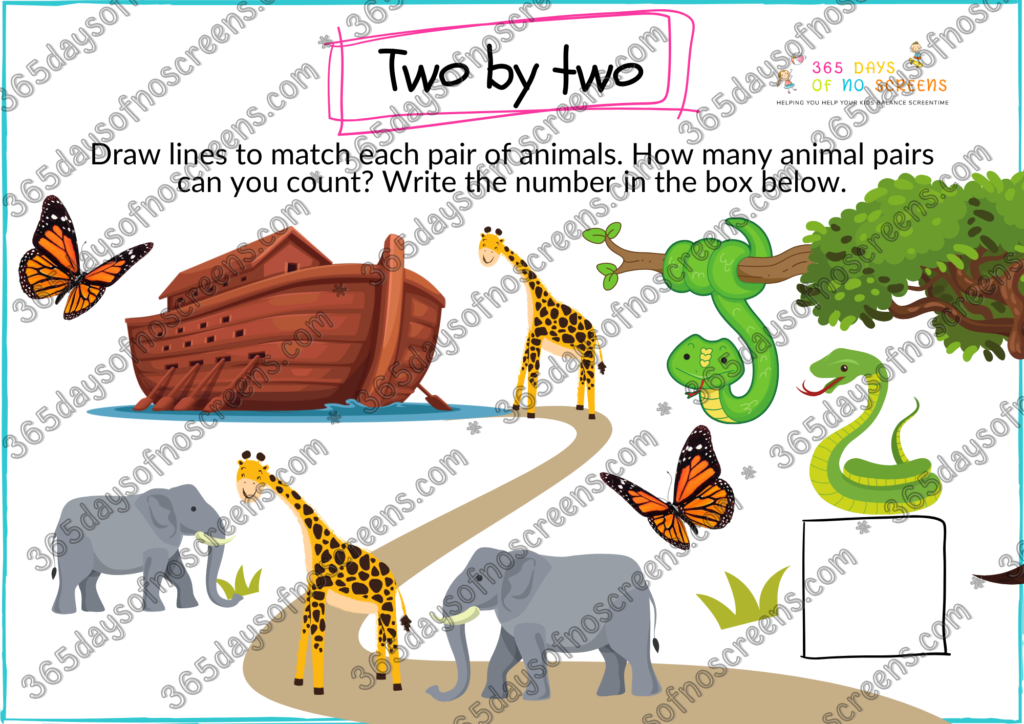
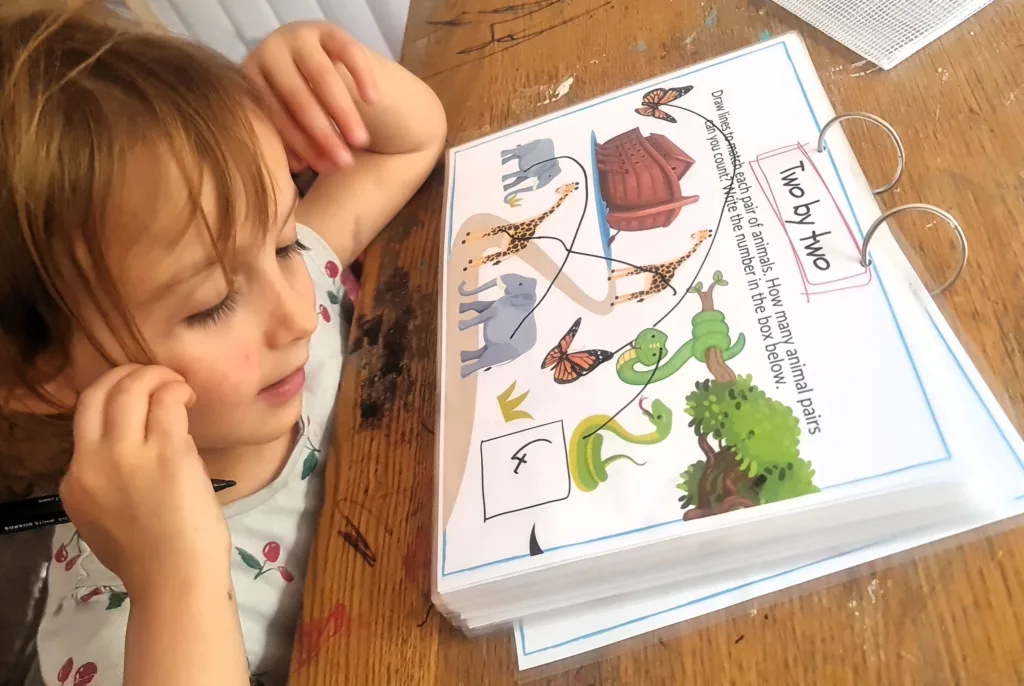
This is another hand/eye coordination activity as your child needs to spot the pairs of items and then draw a line to match them. Then they need to count how many pairs there are and write it in the box below. It’s a great way to teach them what pairs actually mean. And, go beyond this activity by pointing out other pairs, like pairs of shoes, a pair of eyes etc.
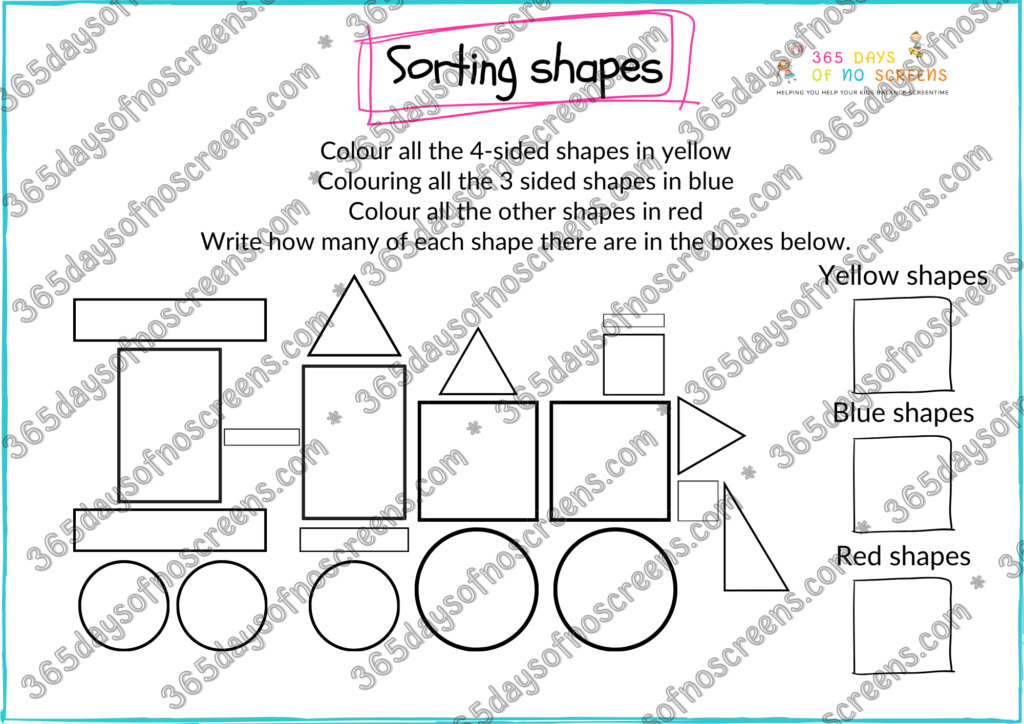
Introducing non-verbal reasoning and logic problems with sorting shapes
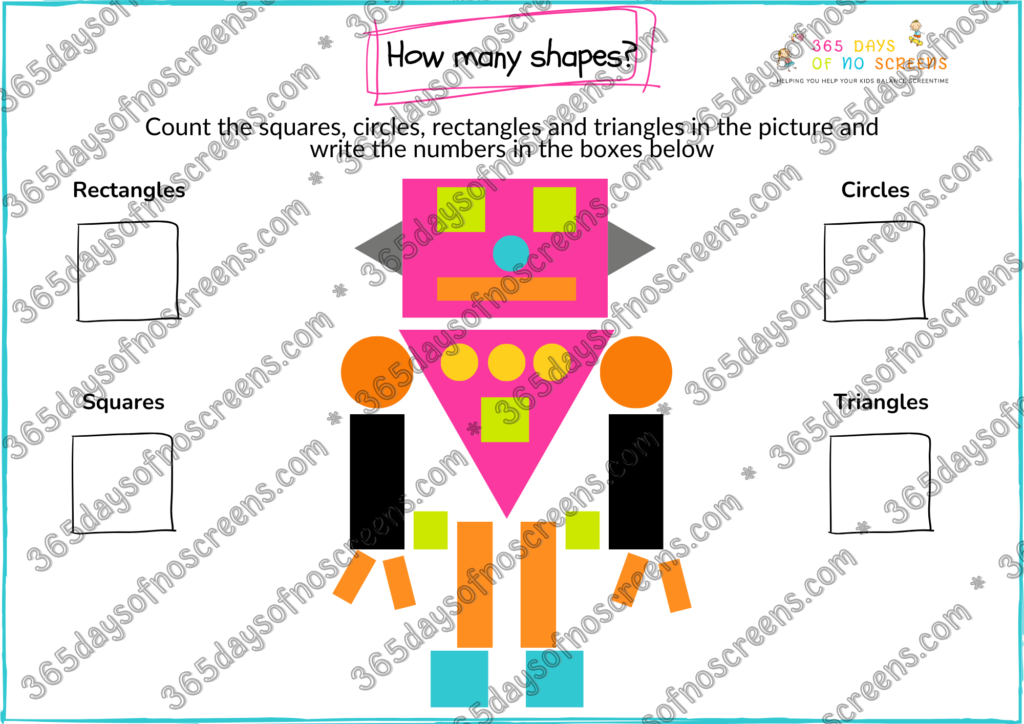
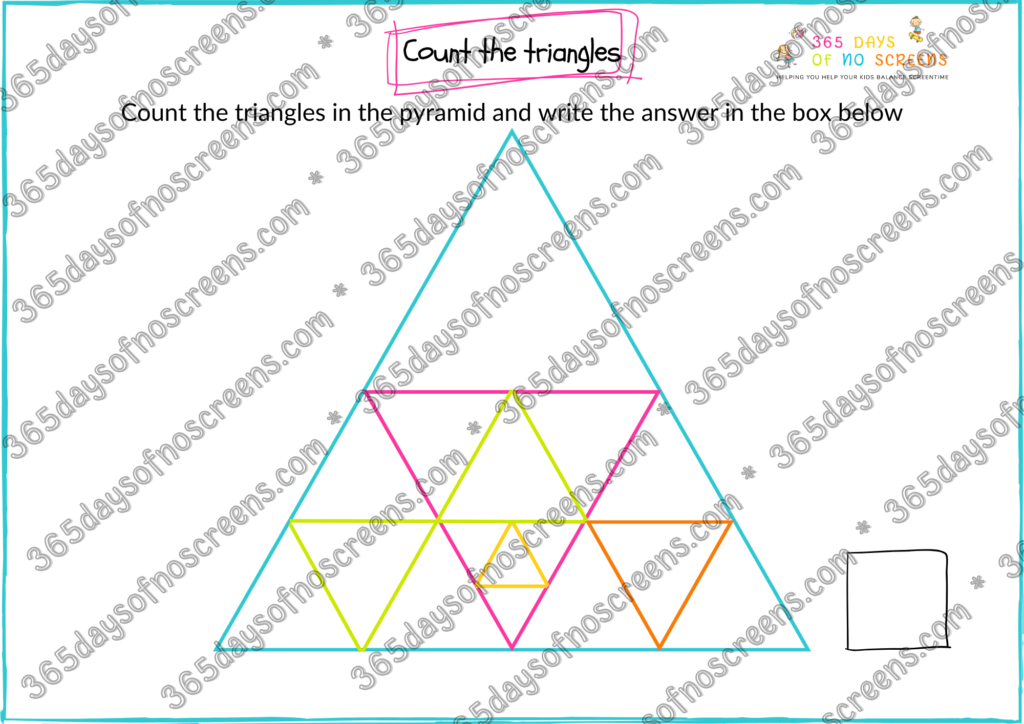
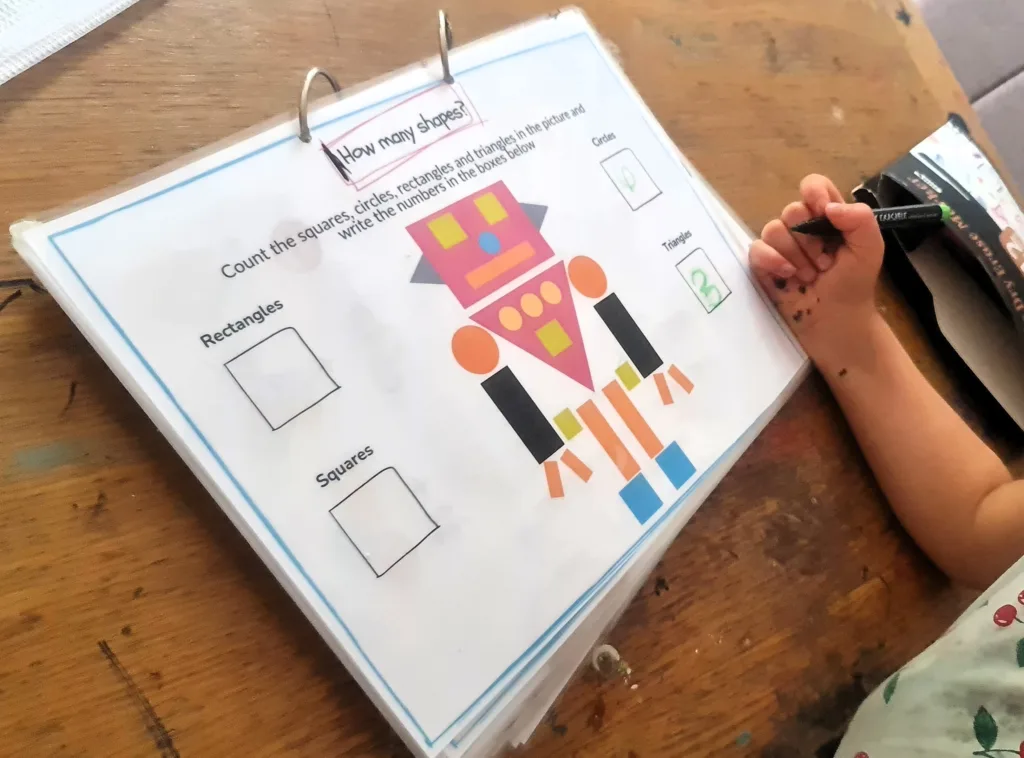
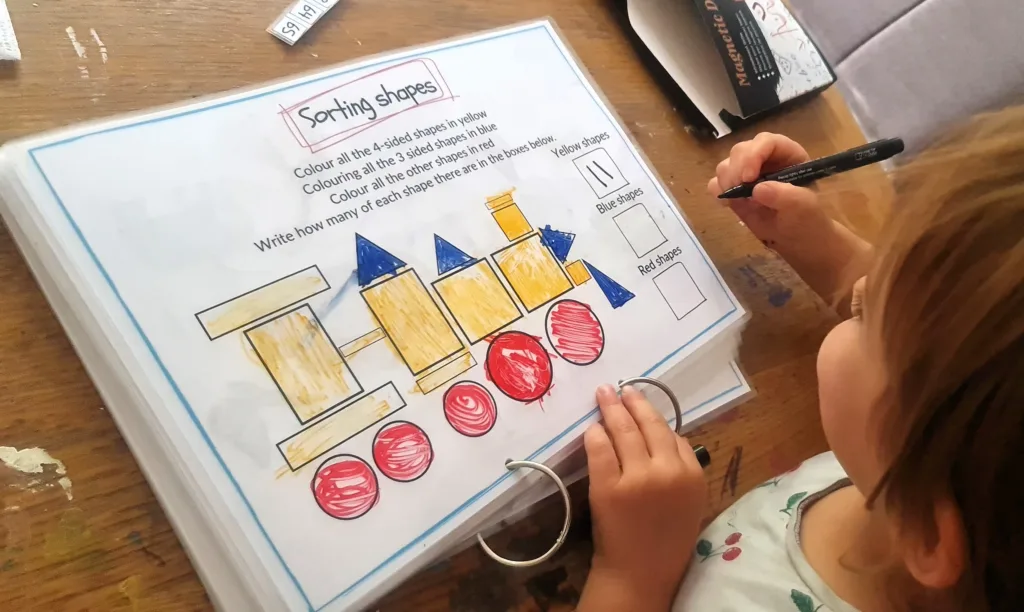
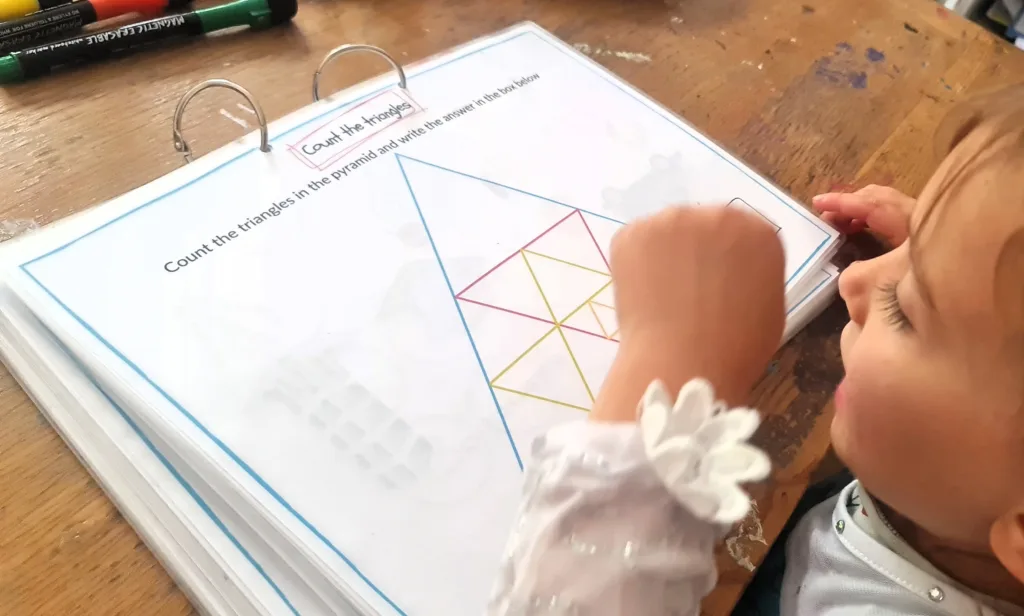
We introduce more 11+ style logic problems (you’ll see more of these in middle school and definitely in more advanced math concepts in high school) relating to shapes by asking the child to spot how many shapes there are in a picture and write the number. It’s also a great way to train your child’s eye to find shapes in everyday objects – plus it’s a fun shape scavenger hunt!
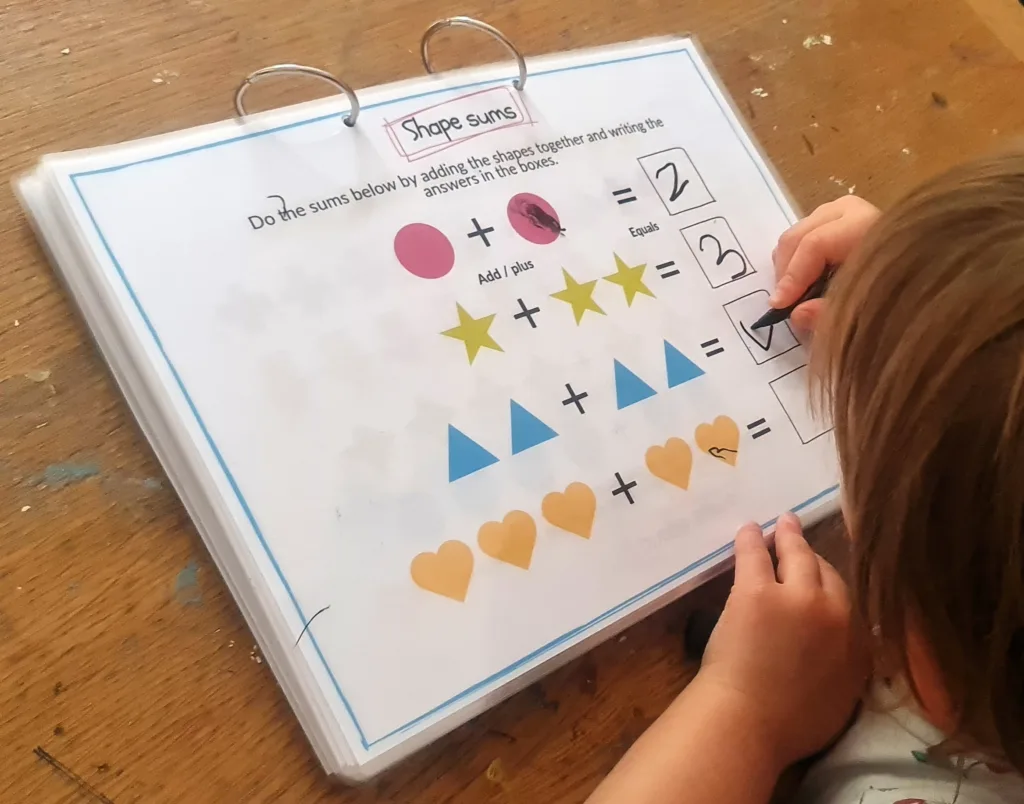
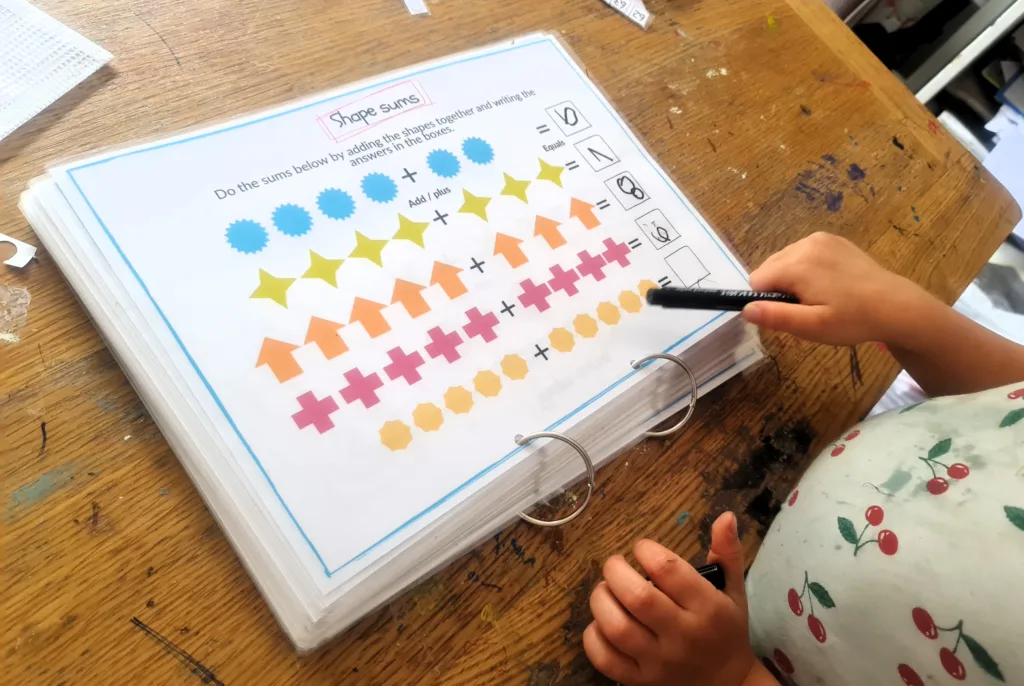
Sums – introducing addition
Taking away – introducing subtraction
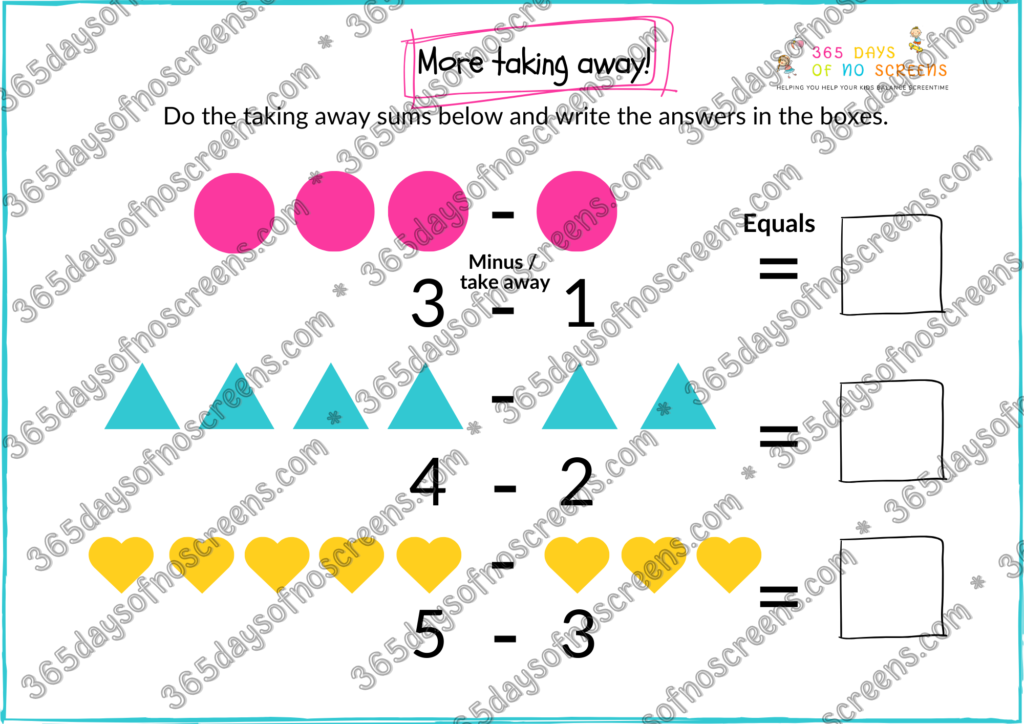
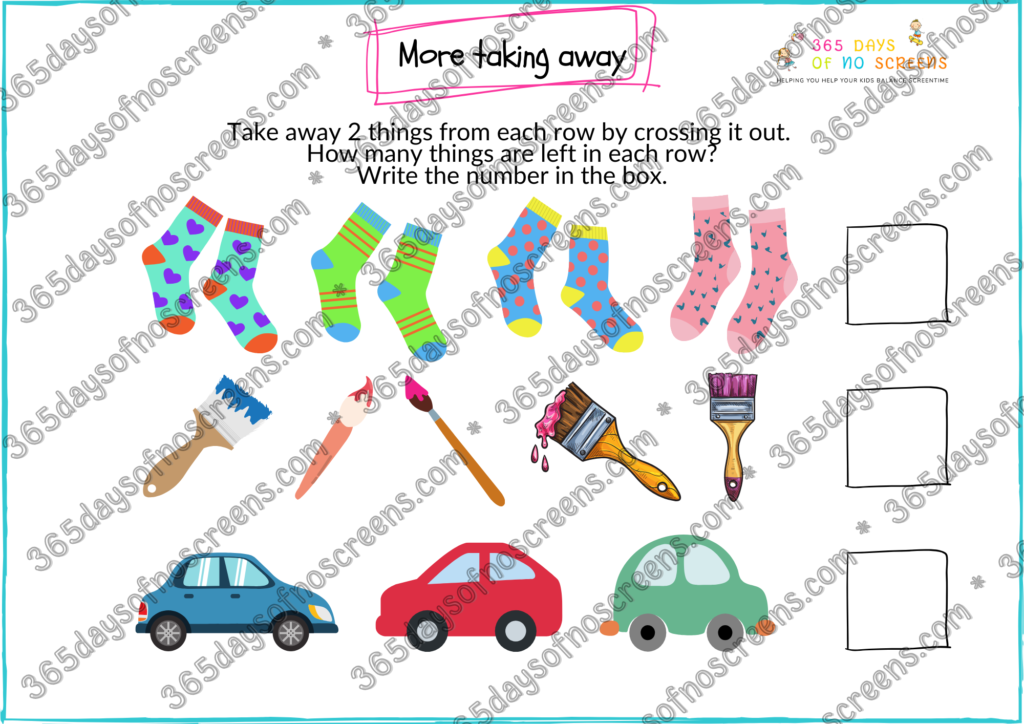
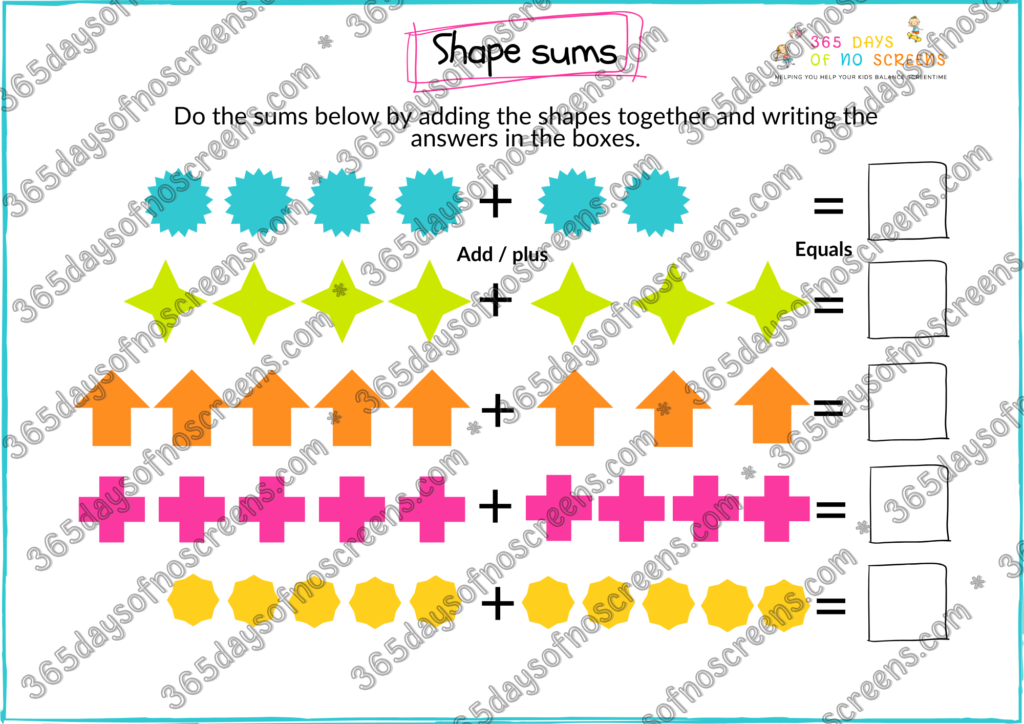
It’s never too late to introduce proper maths! My daughter, at 4 years old, has grasped the concept of adding and taking away, so I included some very basic sums where she can use shapes to add together. Eventually, you can include the numbers so your child can see how the numbers correlate to the shape sum. I offer this kind of basic maths in a variety of different ways, which you can see below. Plus, it’s a good idea to change the problem questions and math facts around, to prepare your child for verbal reasoning!
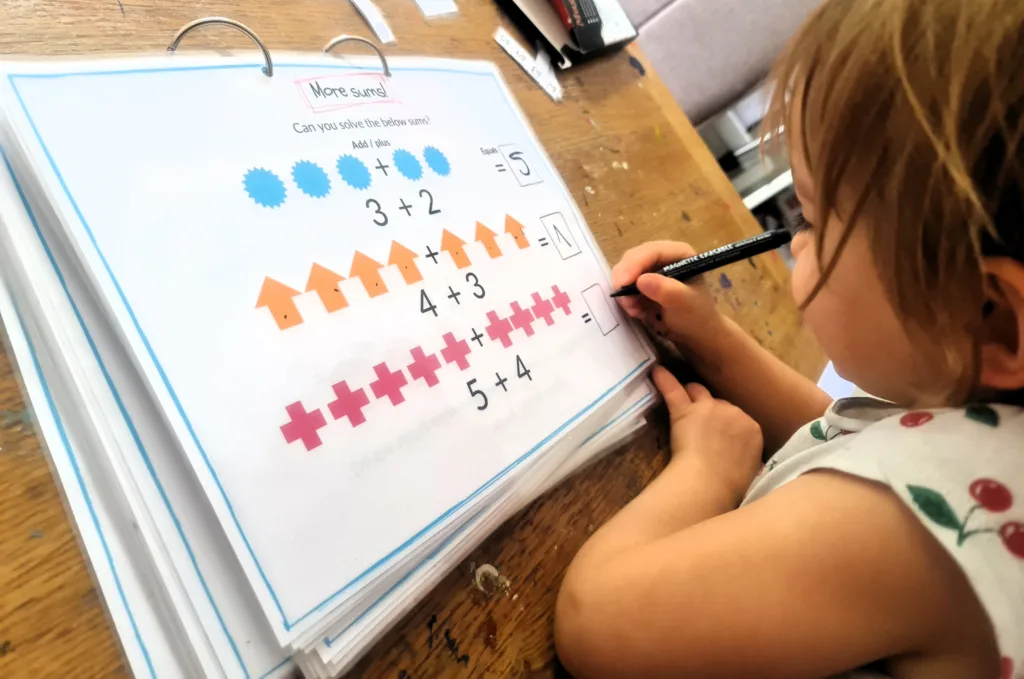
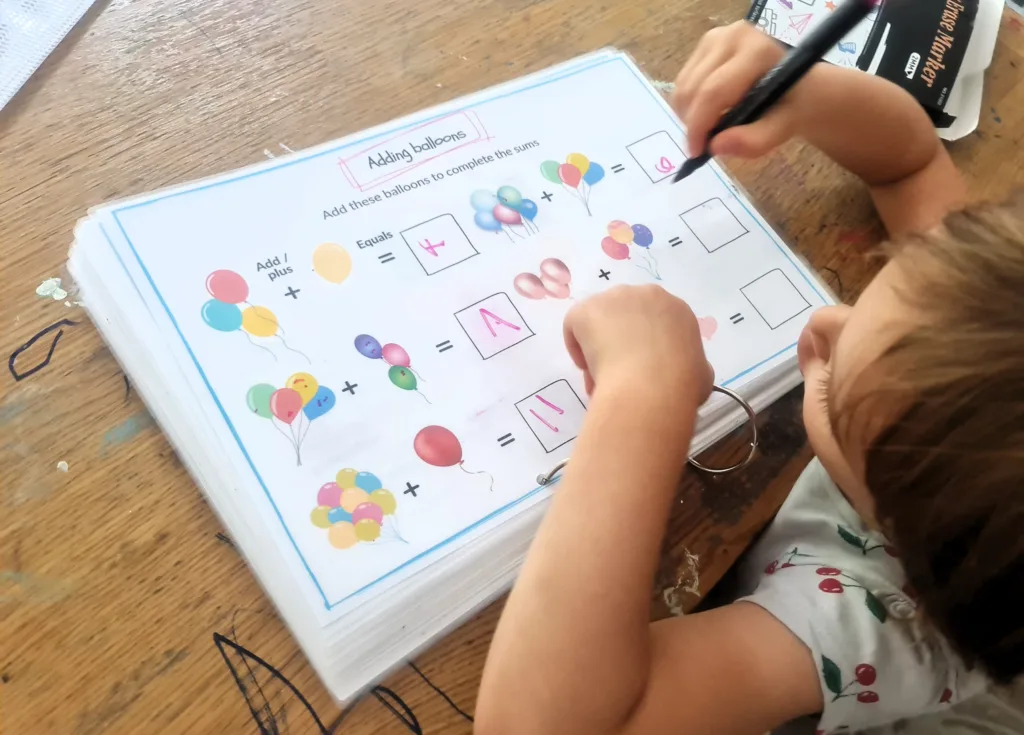
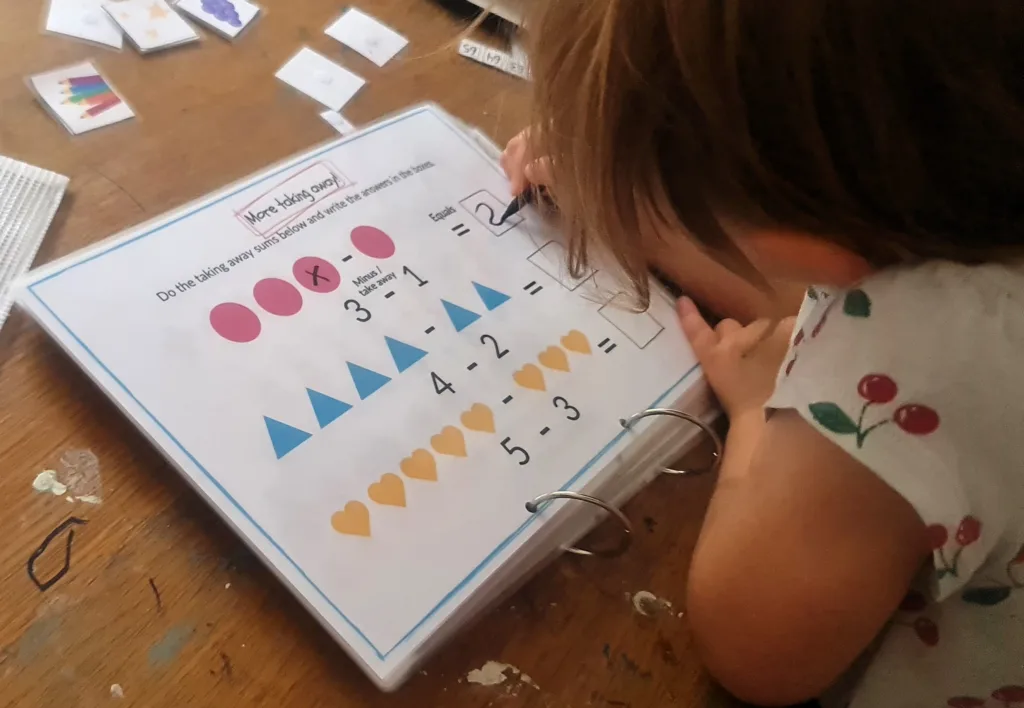
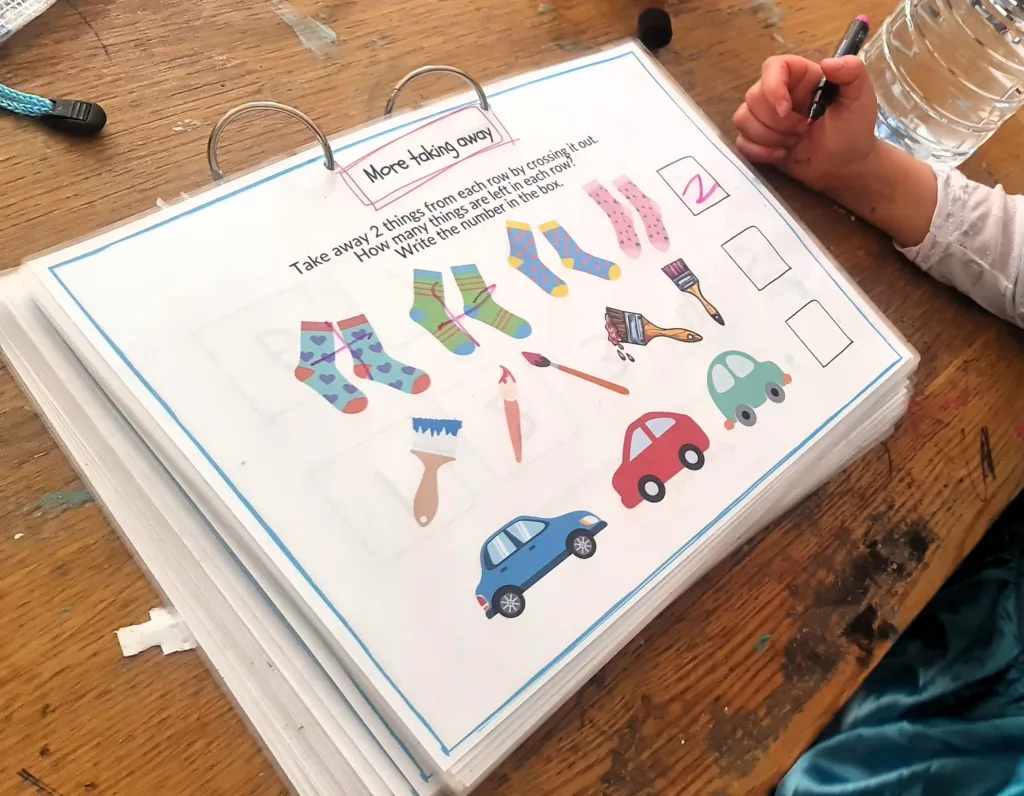
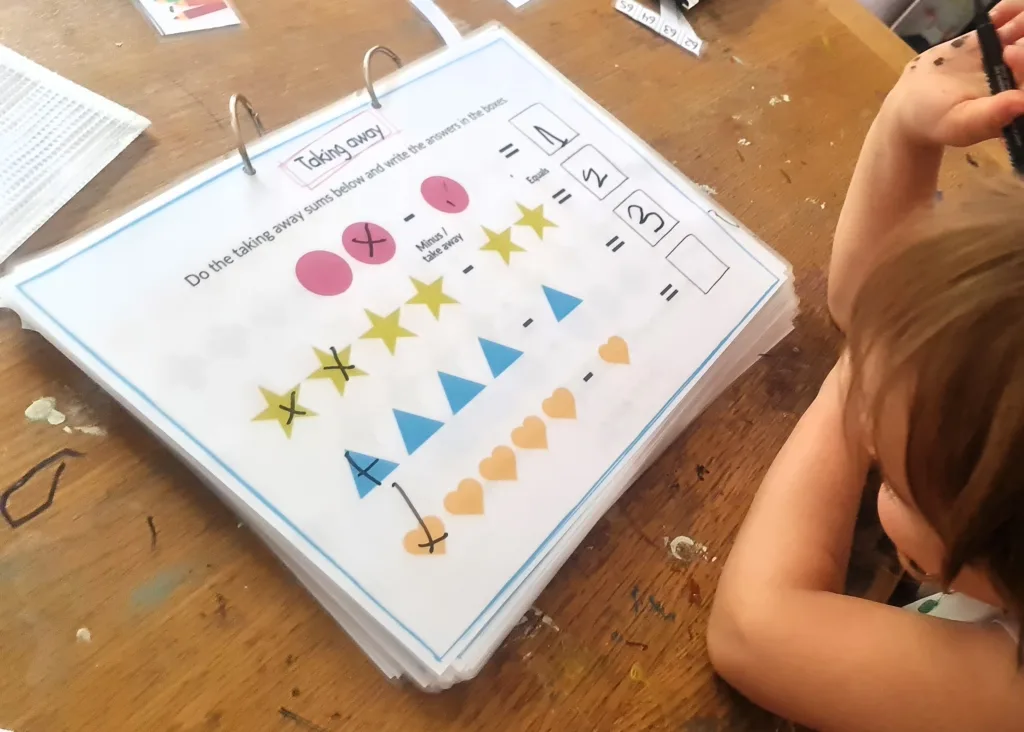
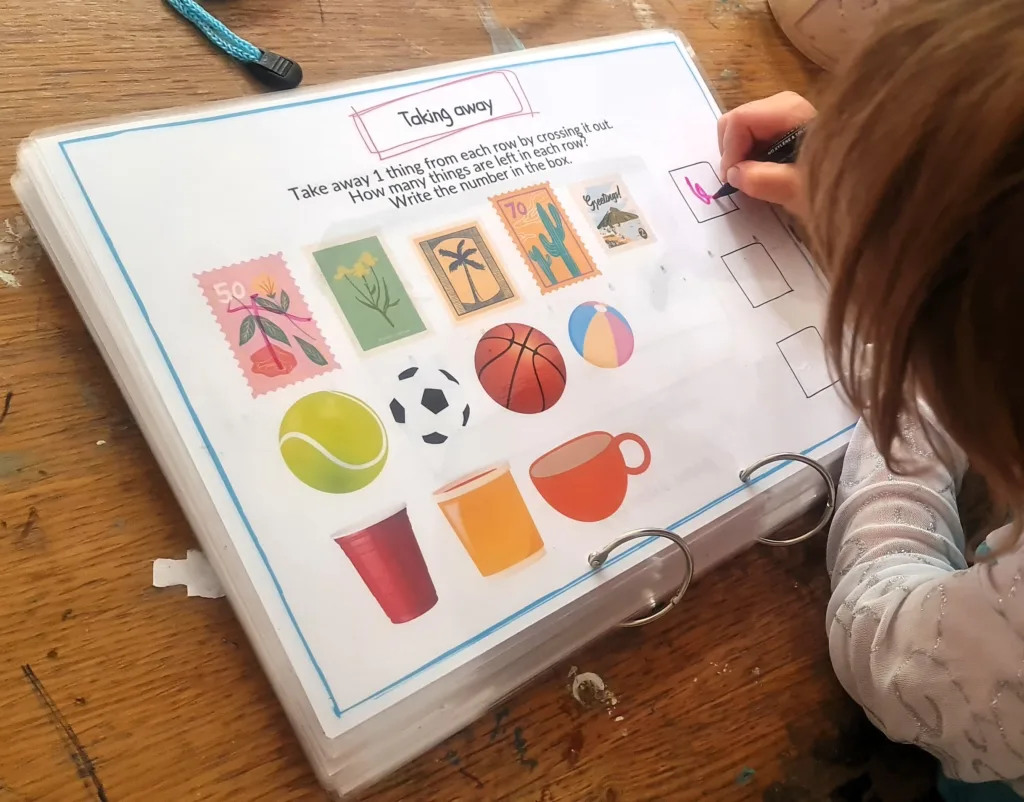
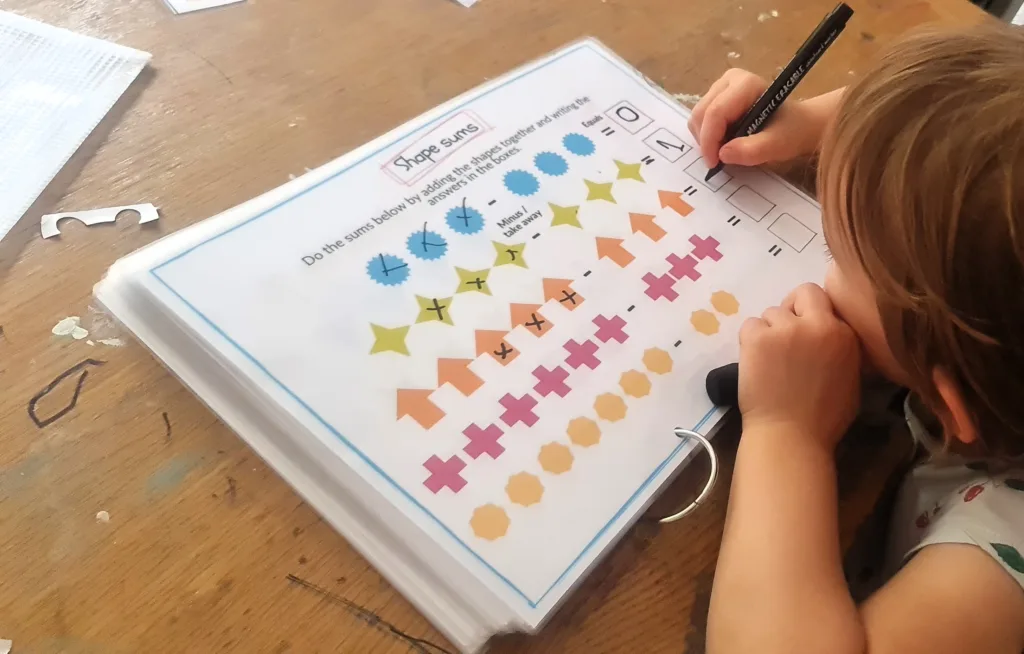
Then, when your child is ready, you can introduce them math number concepts like subtraction, by using everyday objects to take numbers away. Eventually once they get it, you can then introduce division and multiplication skills but we’re not there yet!
Dot to dot in a different way
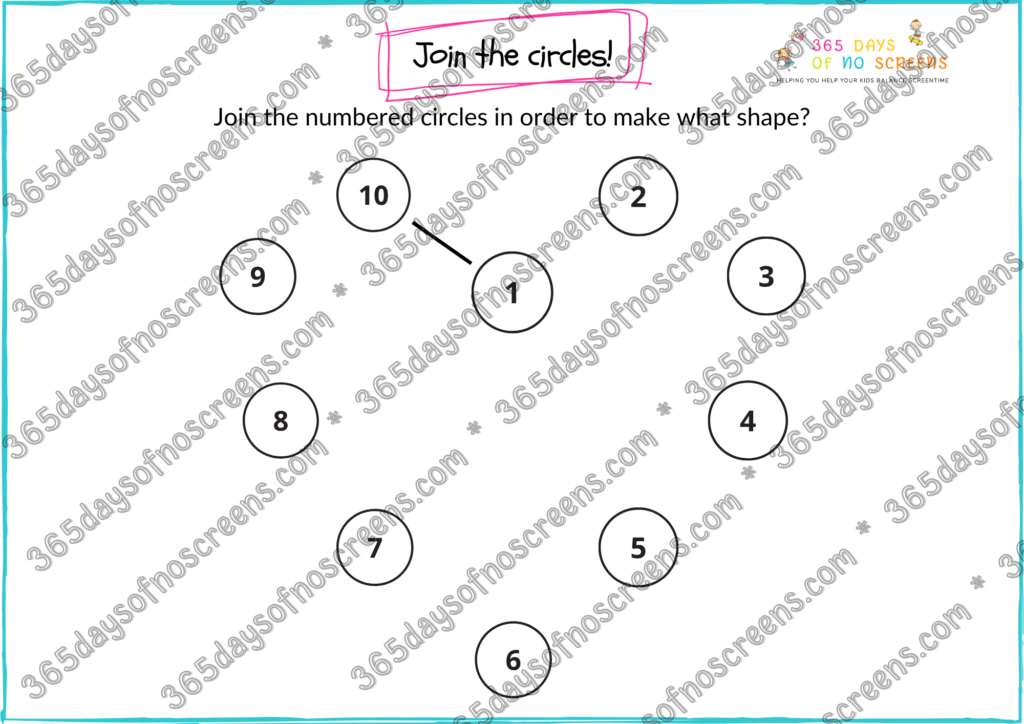
I even cover more dot-to-dot fun, but in a different way, to challenge those awesome brains!
More interactive numbers!
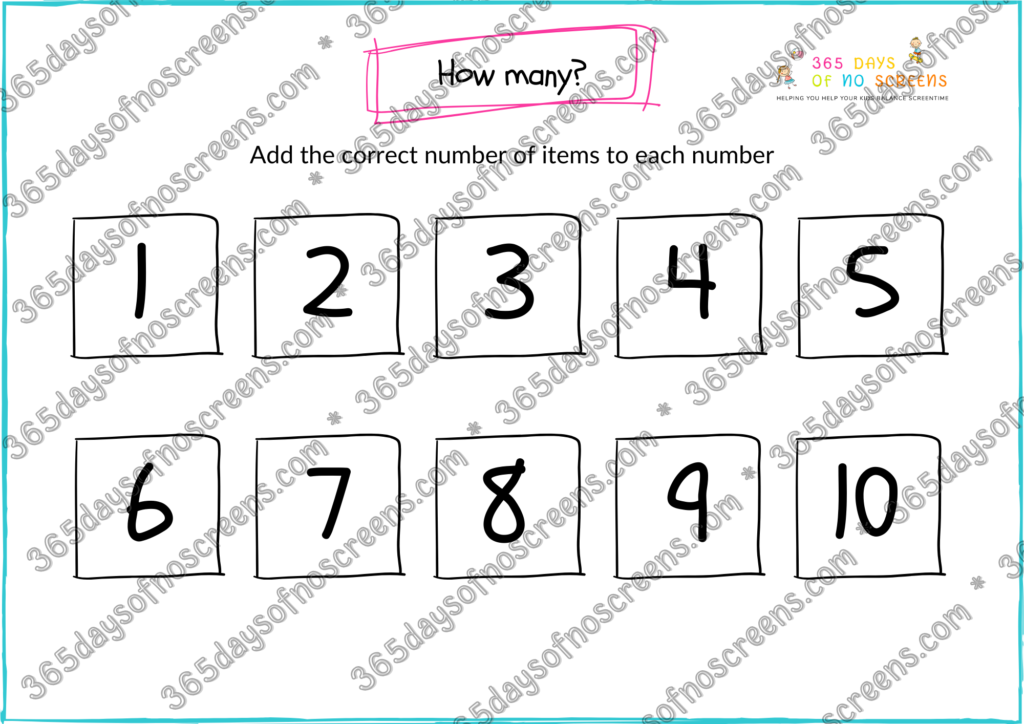
This is an interactive activity where your child looks for the objects with the number of items that match the above grid.

Added bonus – your child can take this type of game outside and find the number of items in your garden via a scavenger hunt and then match them to the numbers.
Counting to 30
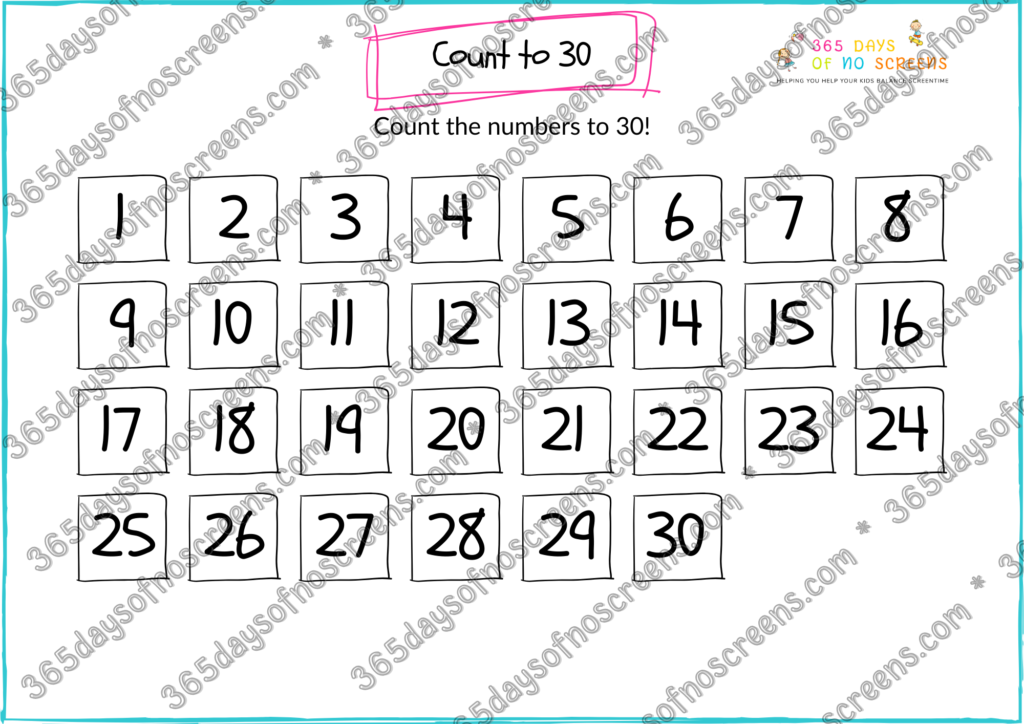
We’re moving on to counting beyond 10 and even 20 now. Let’s introduce numbers up to 30!

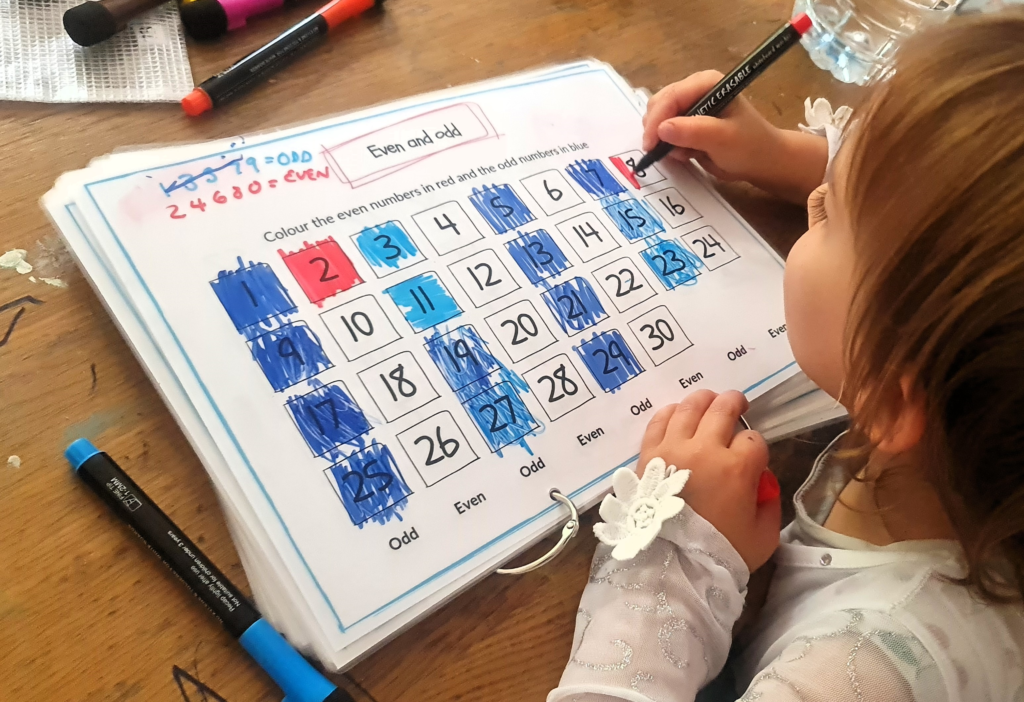
Even and odd
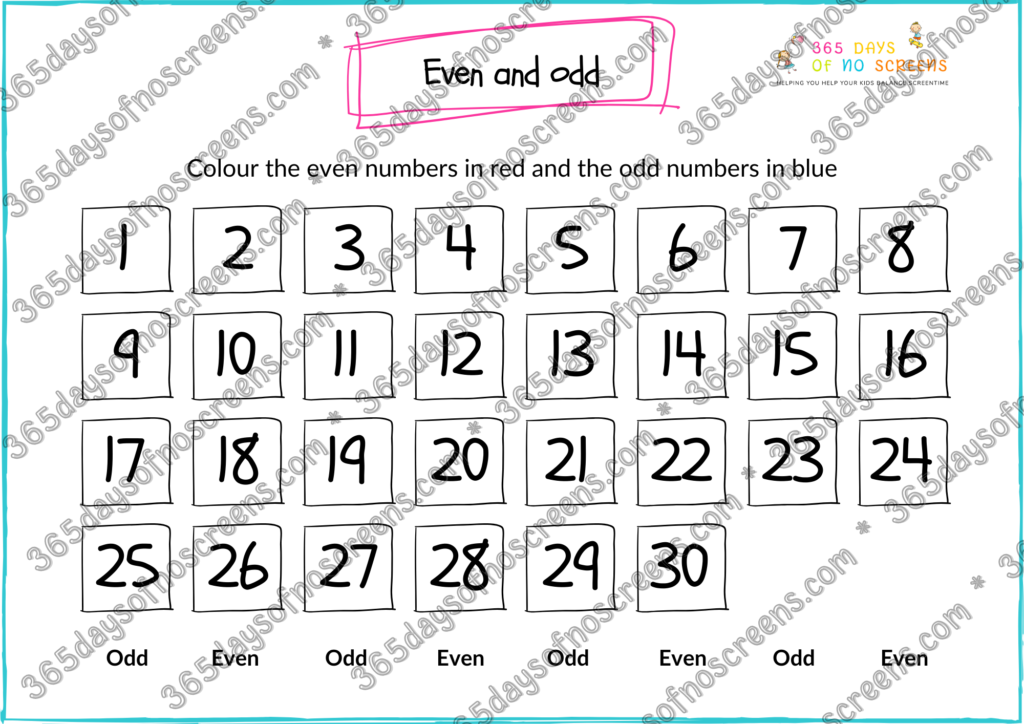
This is a good time to introduce the concept of even and odd. You can use the ’30’ grid to show the even and odd patterns and colour each in different colours. Your child will see that they alternate.
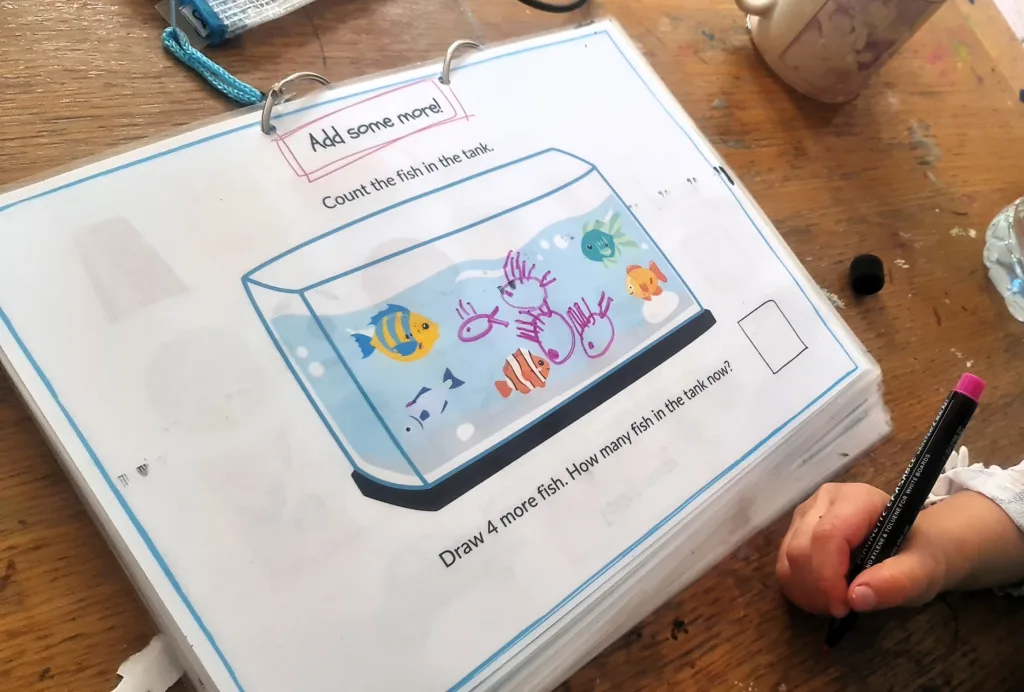
Maths by drawing
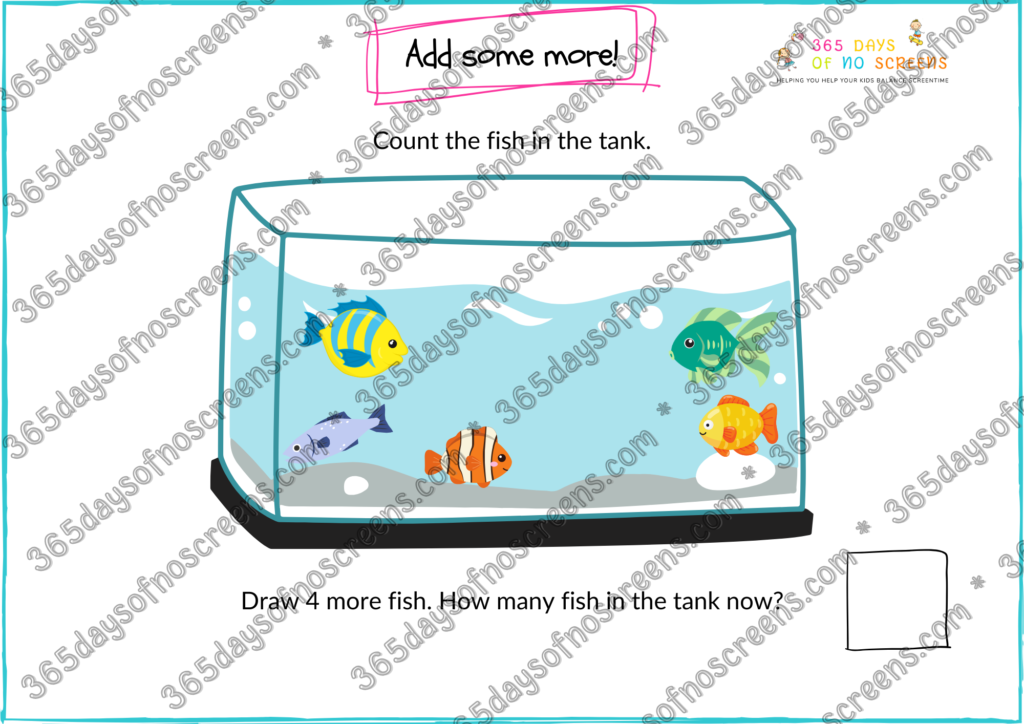
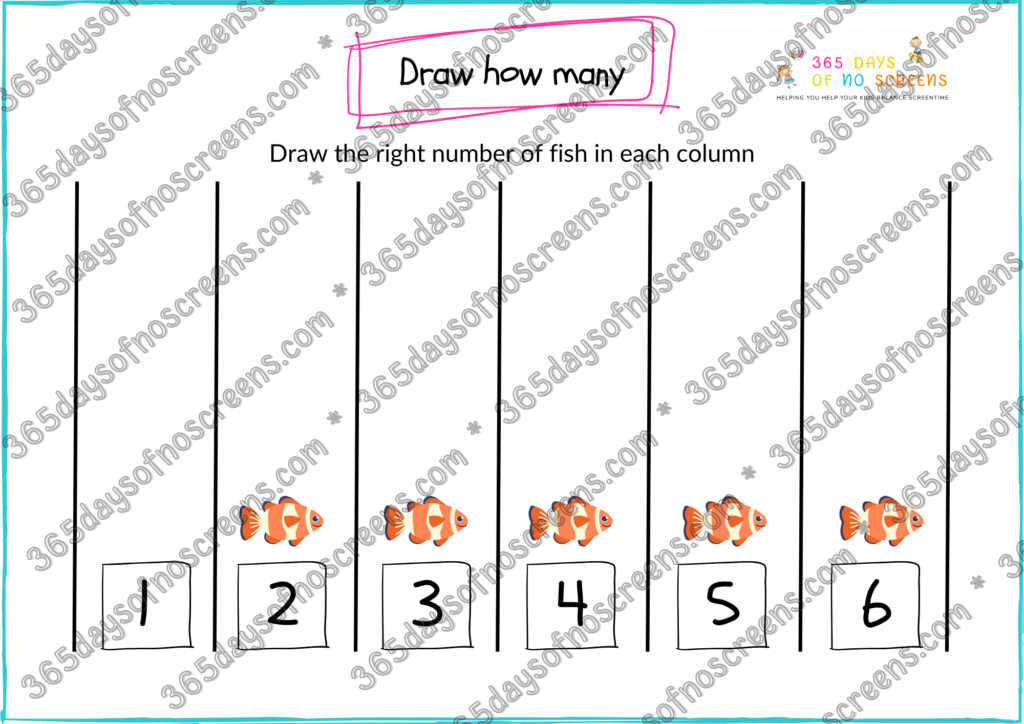
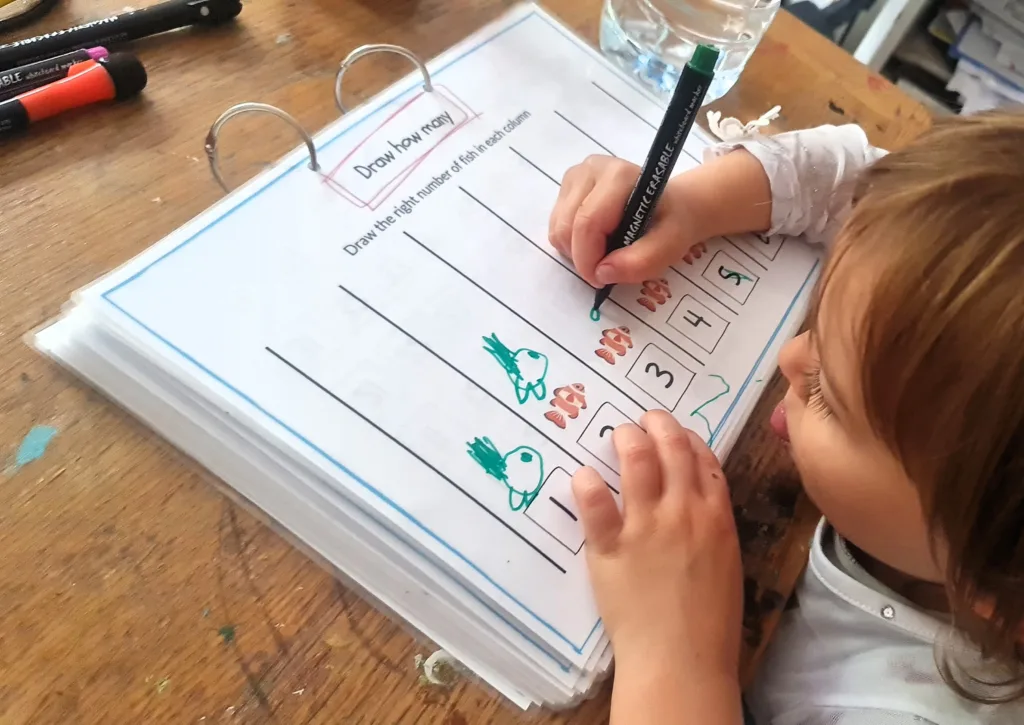
A great way to cement the concept of numbers and adding is to draw additional items. I include some examples as seen below:
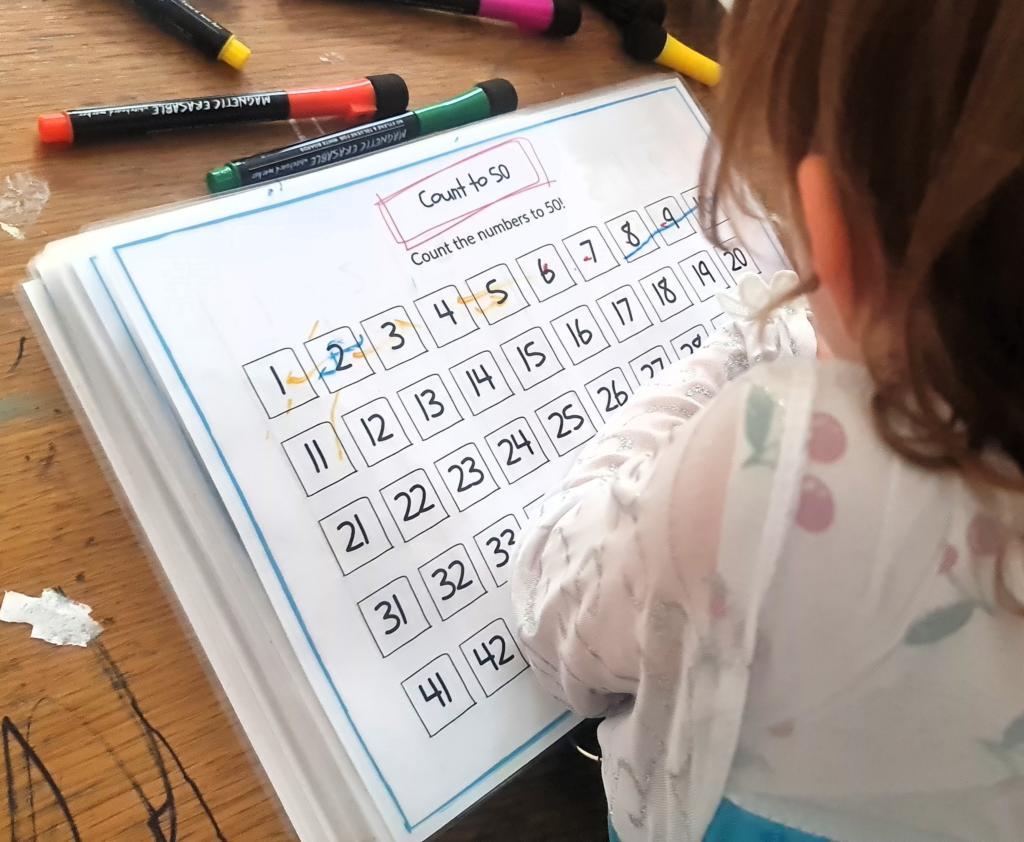
Counting to 50
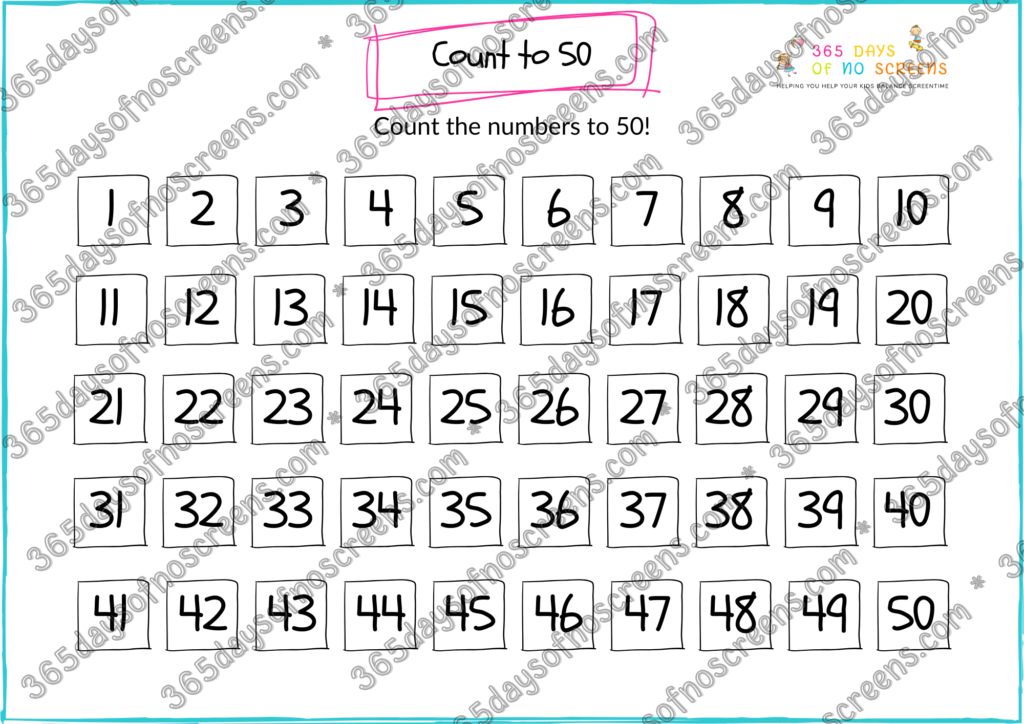
We progress further to counting to 50 now! I’ve placed it in a grid so your child can continue to spot patterns beyond 30. Use this grid to explain the rows, evens and odds and how the ten digits also count up to 9.
Counting to 100
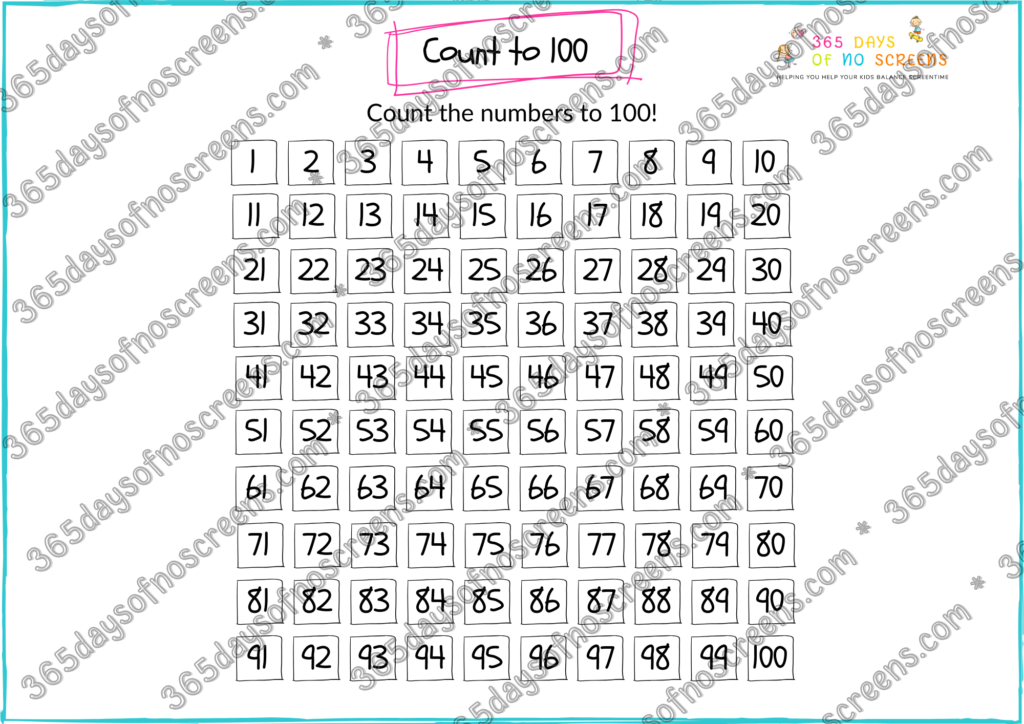
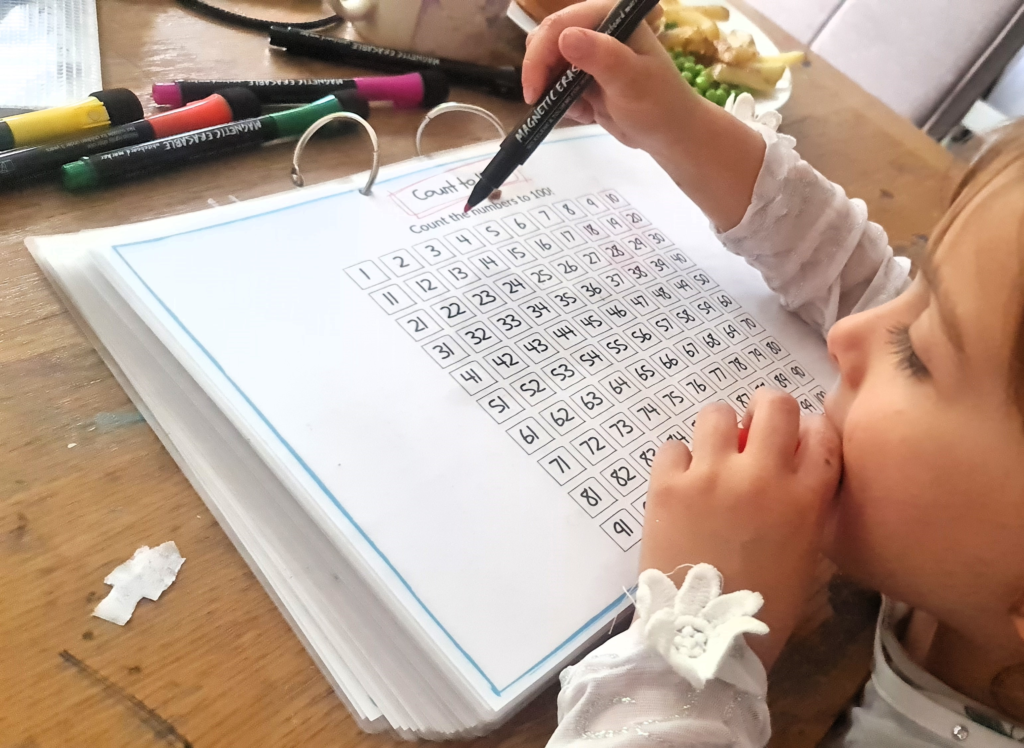
We introduce the 100 grid! What happens after 50? Let’s find out! More room for discussion here because you can continue on about finding patterns and place value.
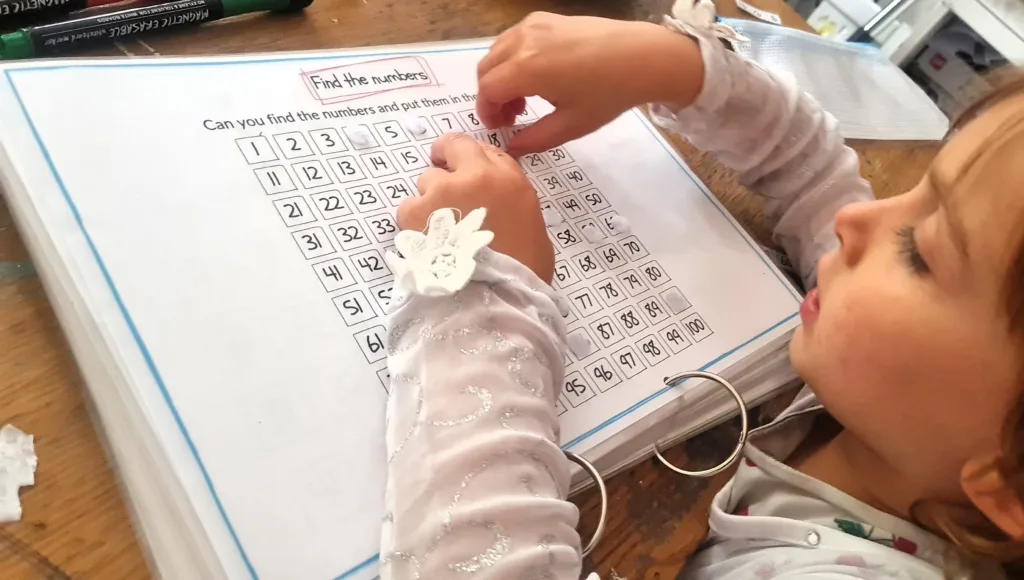
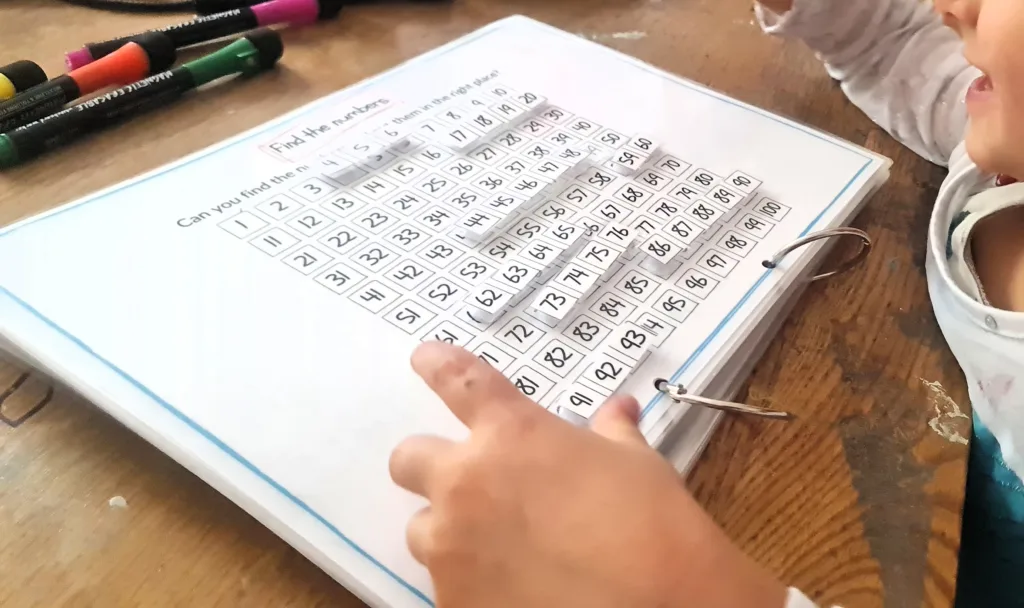
Find the numbers – interactive
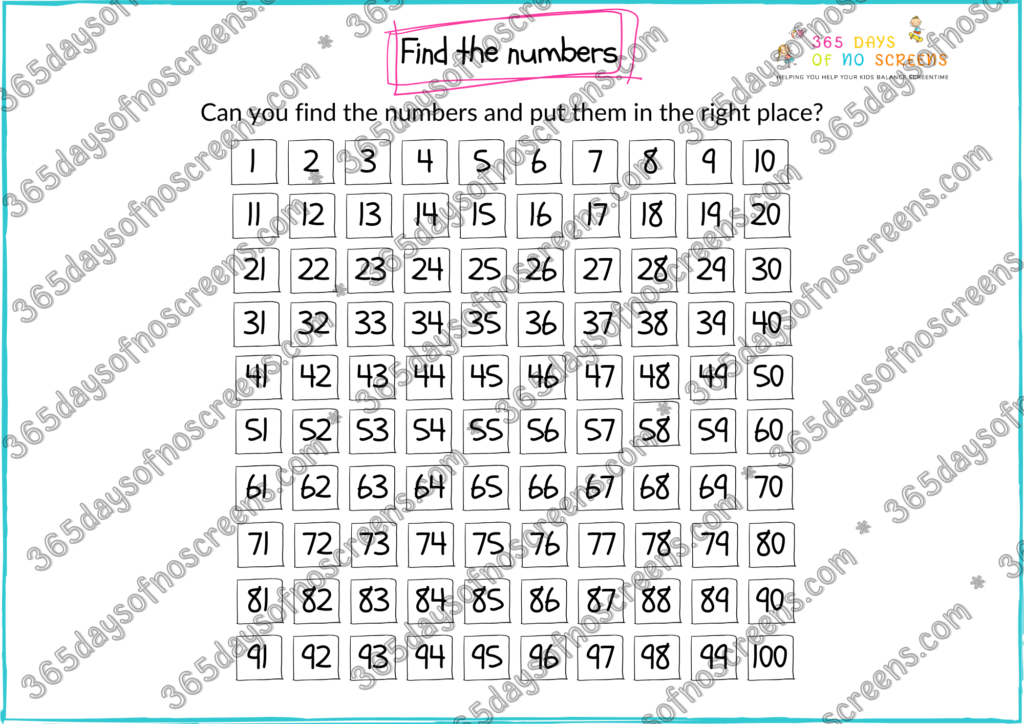
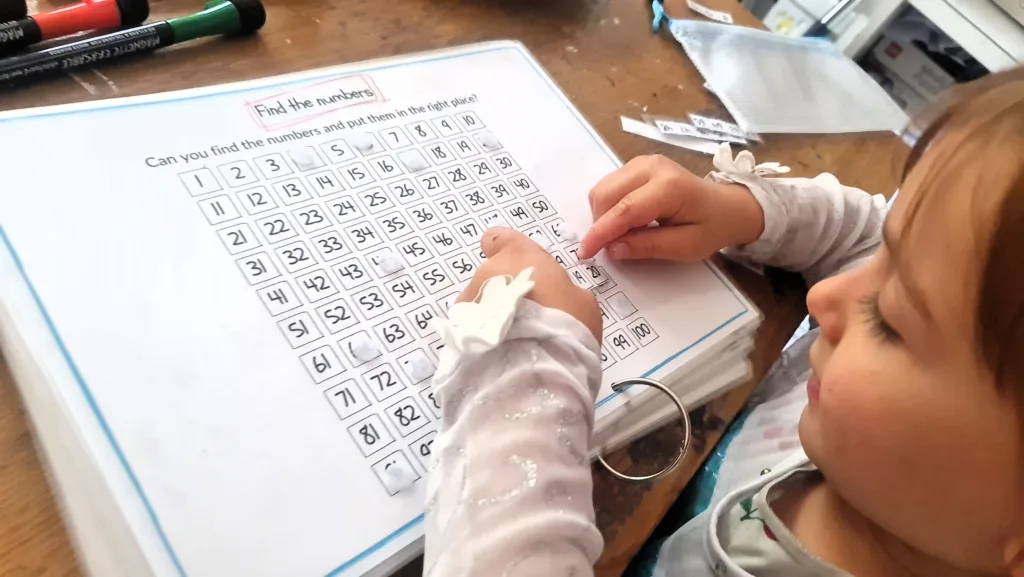
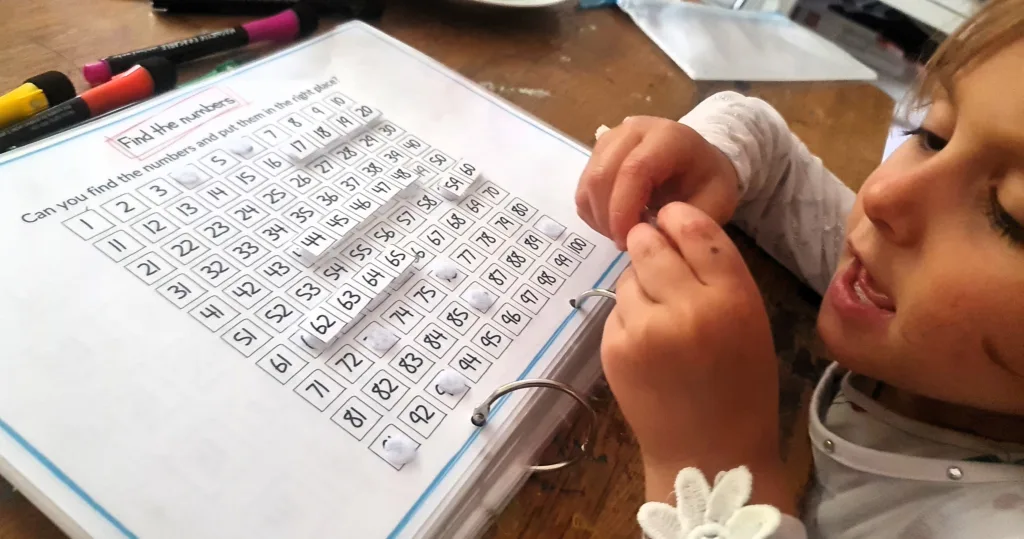
We have an interactive find the numbers, where your child can use the pieces to find rows of numbers which have been cleverly hidden by hook and loop dots. This activity is designed to help your child memorise where the numbers are on the grid, as seen below:
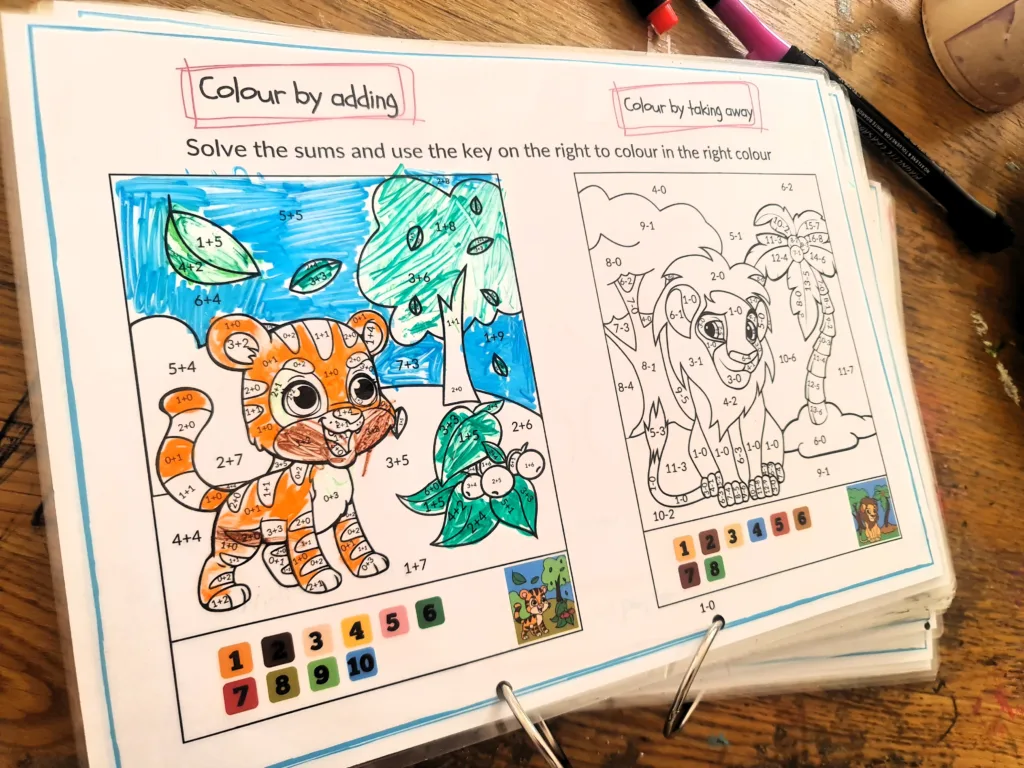
Colouring by adding and taking away
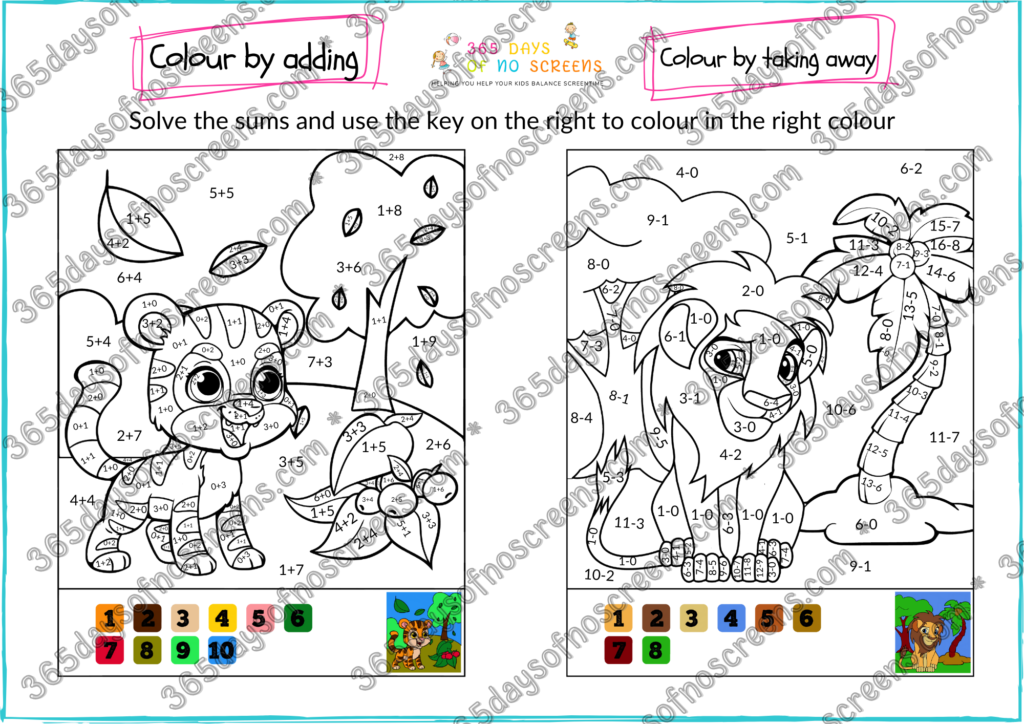
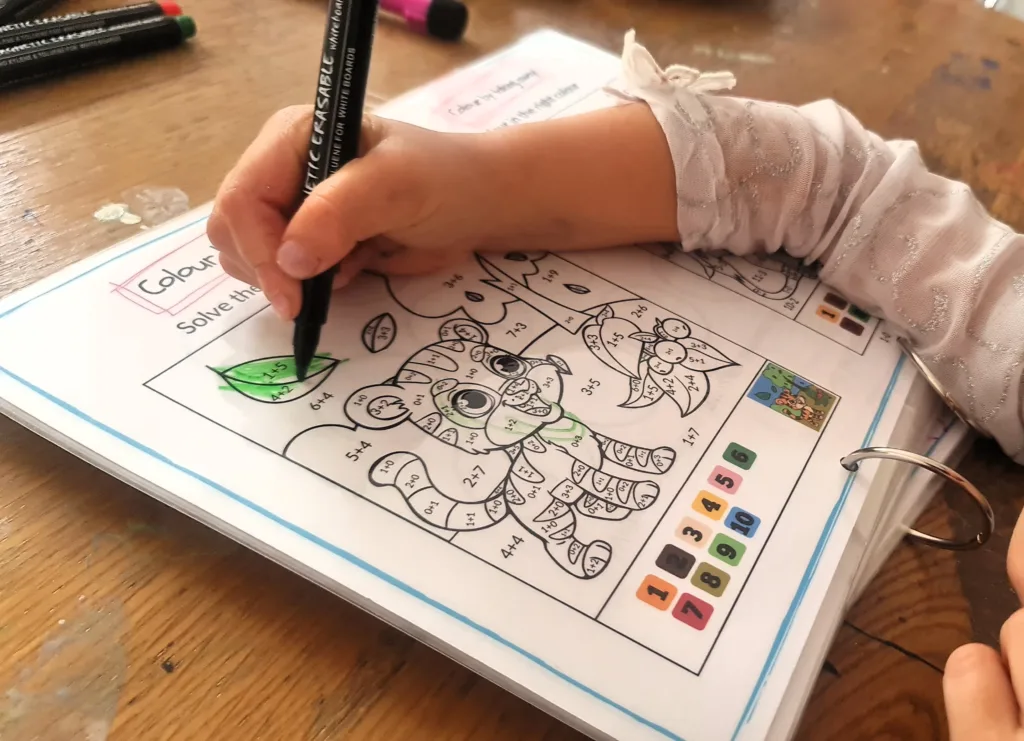
This activity was a labour of love to create! But, oh so worth it as it’s such a fun math game. We introduce a twist to the very basic adding and taking away equations, the results of which have their own colour. Help your child solve the equations and colour in with the correct colour by referring to the key below.
Test your child’s newfound knowledge!
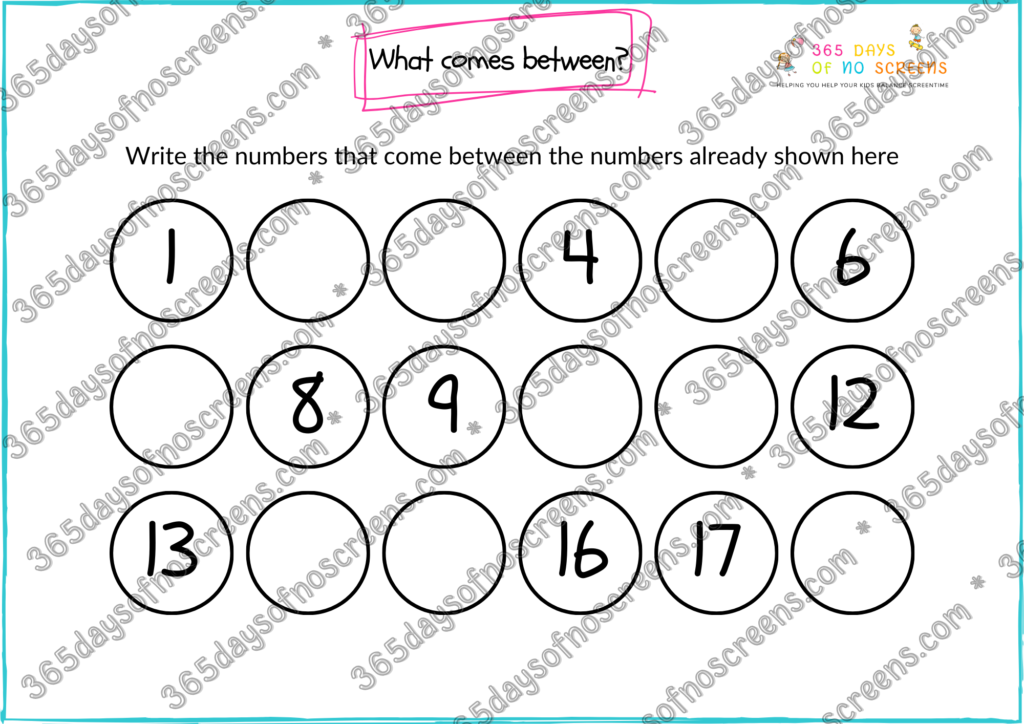
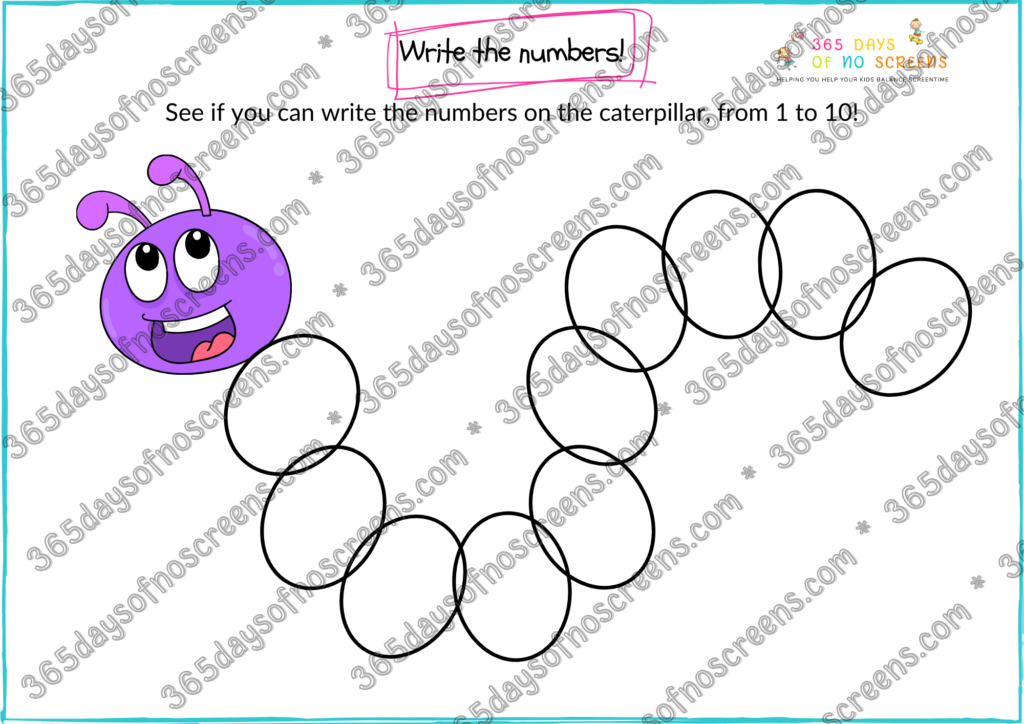
And, finally, I have included some activities to test your child’s newfound knowledge of numbers by asking them to write the correct numbers in the spaces below, with no guided help! If your child is young, they will need help to do this but try to encourage them to do this part on their own if you think they can.
These kinds of motivational preschool math activities not only help build confidence but also get your child set up and ready for high school math activities later!
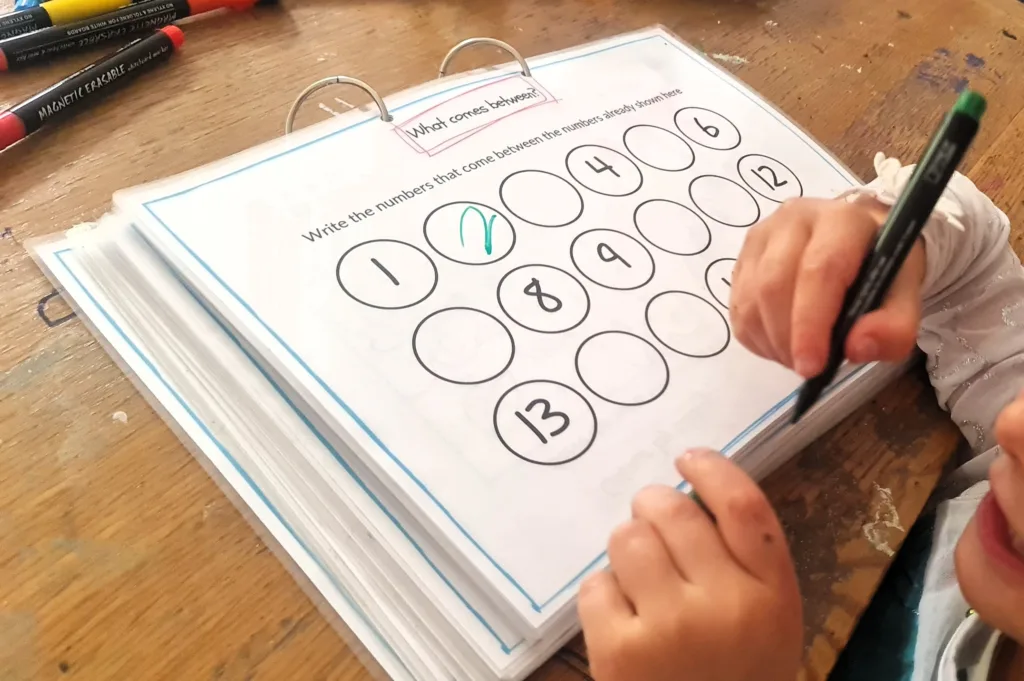
Pieces to cut out for the interactive laminated Maths Activity Book
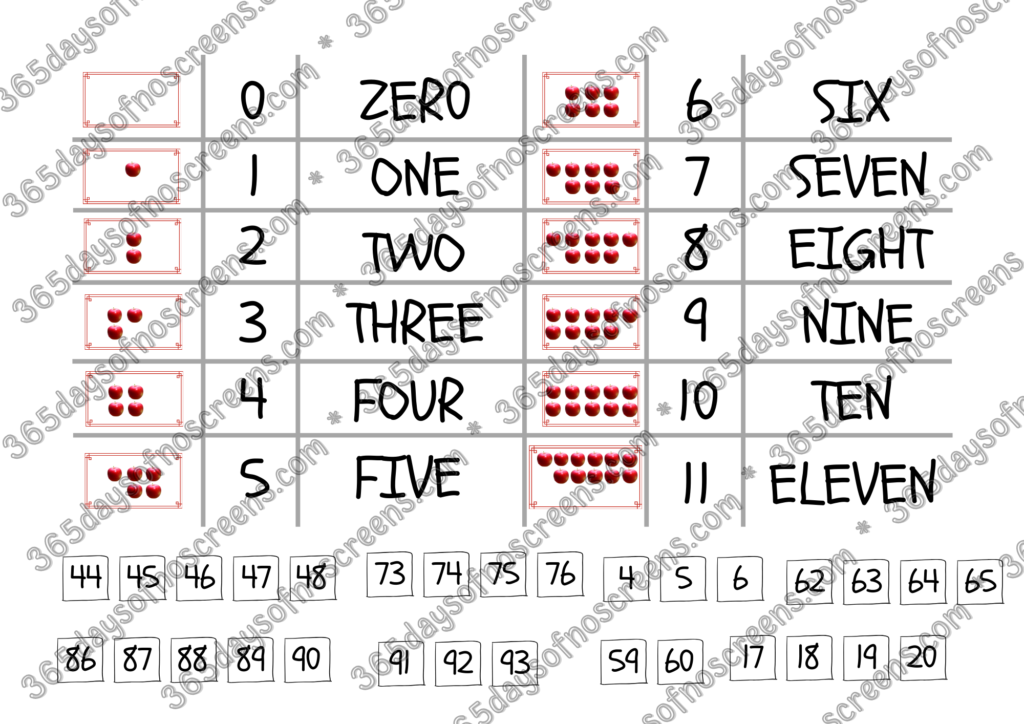
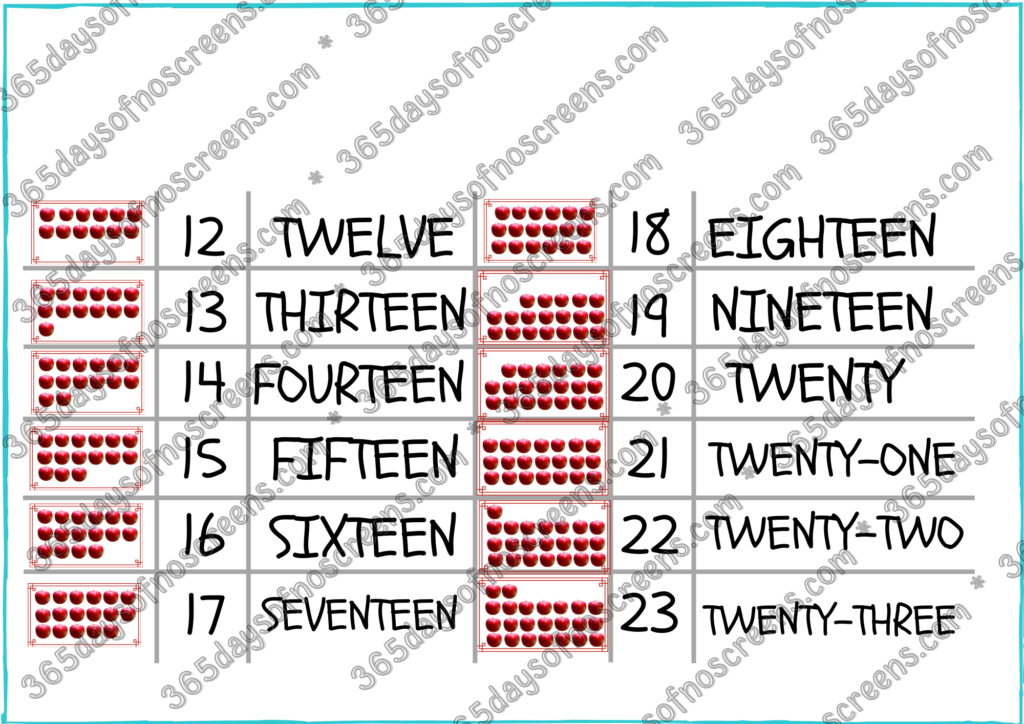


Finally, you have all the pieces you need to make your book interactive! But, don’t worry, we will go through this bit now.
Let’s make the book!
Here is the video again for extra help:
BUY YOUR CANVA TEMPLATE TO THE MATHS ACTIVITY BOOK HERE
You can grab the Maths Activity Book from Etsy here* or from my website here* to get started. You will get instructions and a non-personalised PDF version of the Maths Activity Book. If you want to stop here, you can. Print your PDF book or buy the print version on Amazon here* and enjoy!
If you want to personalise the book at least, follow the instructions below or in the purchase documents you received with the purchase. You can also follow the video here:
Click the link in your instructions to access the Canva template, which should automatically open up to the main page:
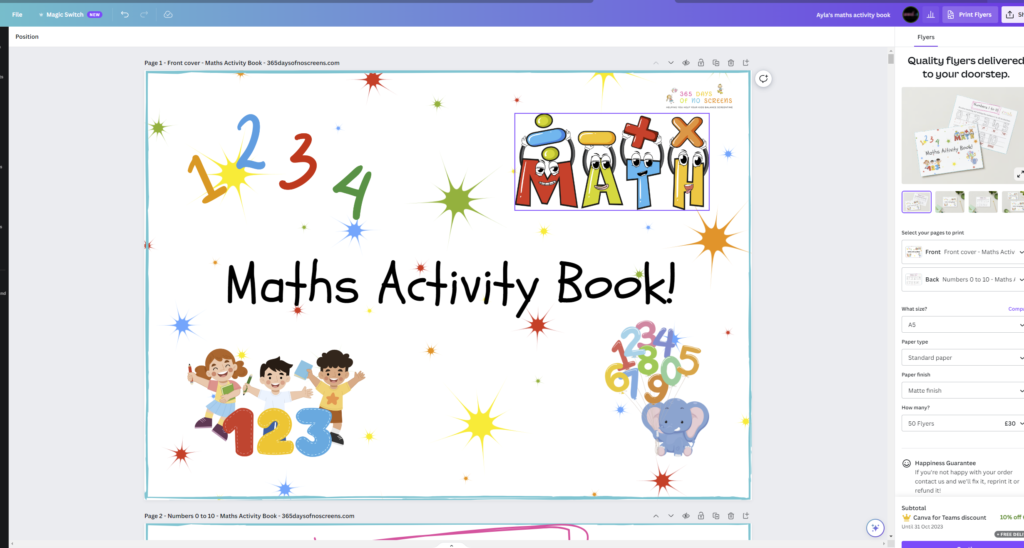
Double-click where it says ‘Maths Activity Book’ and write your child’s name.
If you don’t have the Canva Pro version, then you will need to go in and replace all the elements with basic elements.
Once you are done, download your PDF for printing. Don’t forget to save it in a new name!
Step three – print out your sheets
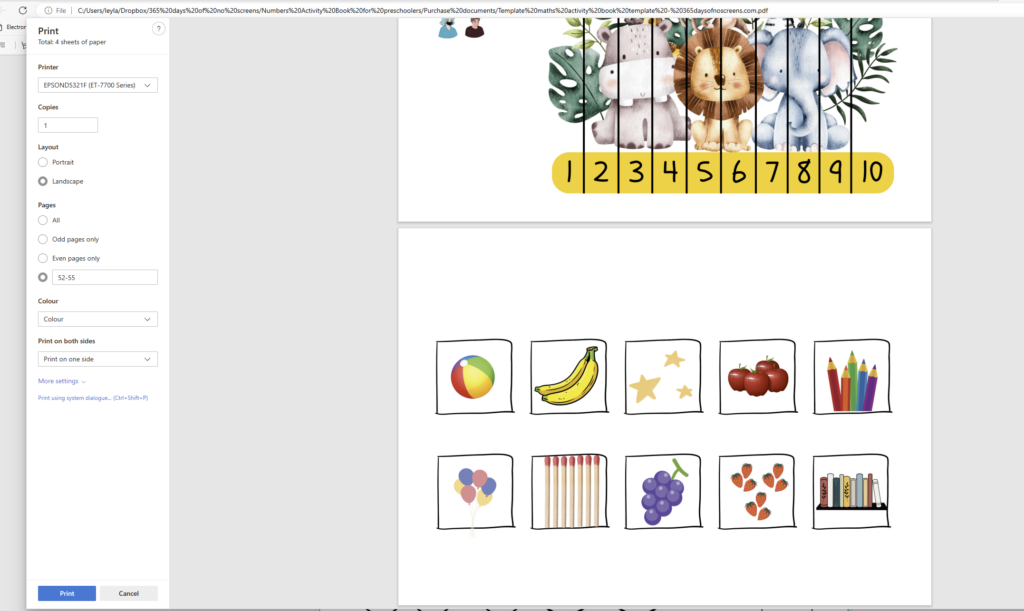
Print the first 51 pages front to back in high quality and landscape.
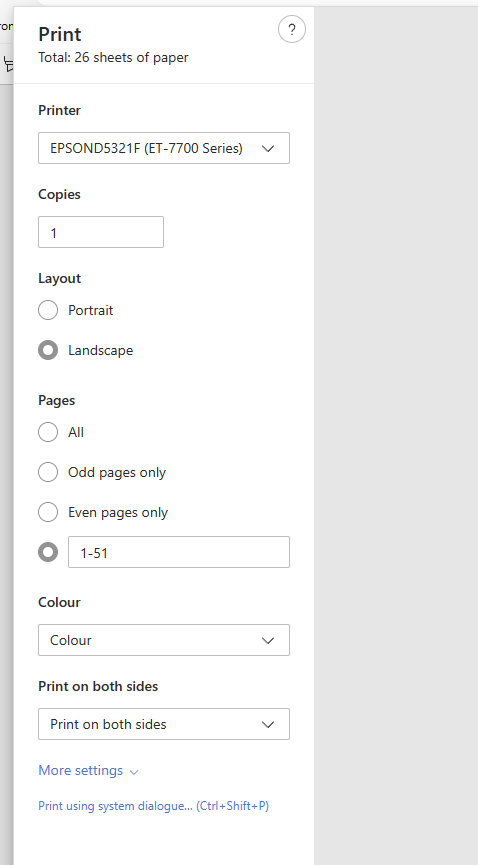
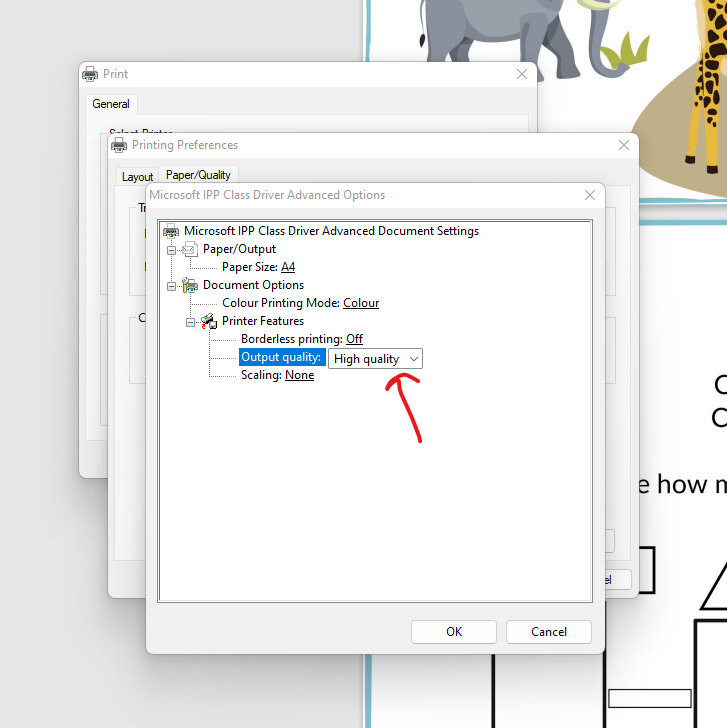
Then the last four pages in high quality and one-sided.
Step four – laminate!
Once you’re done, laminate your first 51 pages using one laminate pouch each
With the least four pages you printed, cut them out and place them evenly onto one laminate pouch. You will cut them out again once they’re laminated.
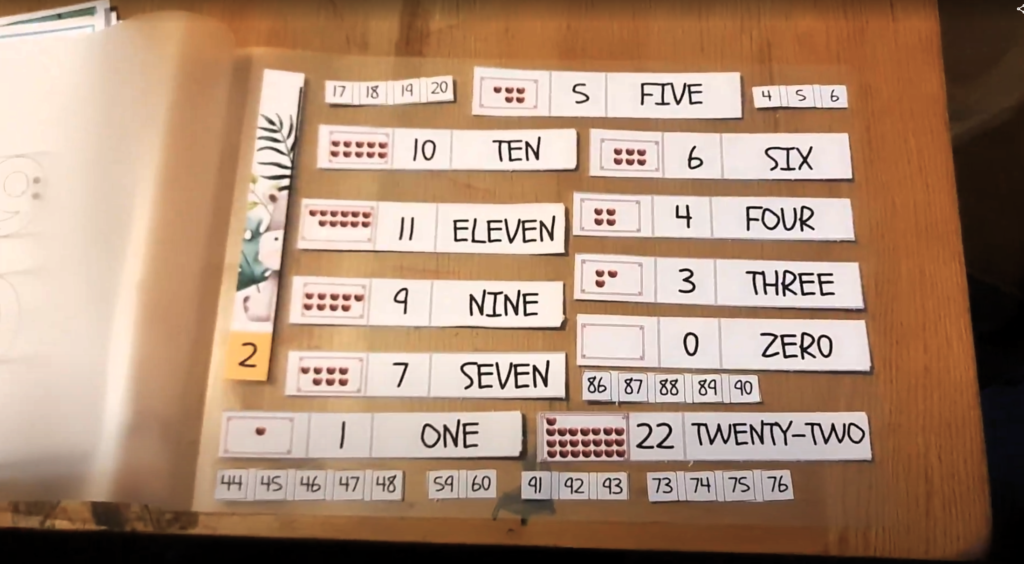
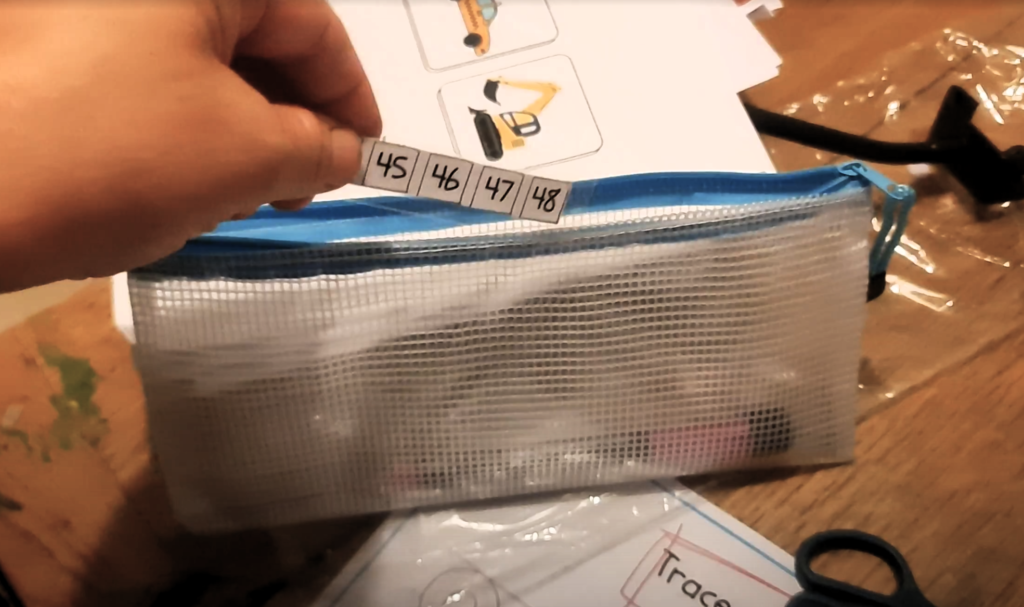
Pop all your pieces in a pencil case while you build your Maths Activity book.
Step five – pull everything together
Hole punch your laminate pouches and put them in the keyrings to hold them into place. Add hook and loop dots to all the interactive pages of the fun maths activities, which are:
- Pages 2 and 3 – Numbers 1 to 11 and Numbers 12 to 23
- Page 17 – How many people?
- Page 20 – Number order
- Page 40 – How many?
- Page 46 – Find the numbers
Step six – Enjoy!
Your Maths Activity Book is ready! Please share in the comments below how you got on with all the creative maths activities with your child. If you tag me on Instagram here using @motherhooddiaries or Facebook group here or here using the tag #365daysofnoscreens with your pictures /videos. And why not get your child’s buddy involved so they can work on the Maths Book together! You can reward them with cookies or stickers after.
Can’t wait to see how you got on!
And good luck!
FAQ
What are mathematical activities for kids?
Mathematical activities for kids are designed to be engaging, interactive, and appropriate for their developmental stage. The aim is to foster a love for mathematics, develop foundational skills, and cultivate mathematical thinking from an early age. Here are some popular mathematical activities for kids:
- Counting Number Educational Games: Using everyday objects, such as toys or food items, to practice counting. For instance, counting the number of apples in a basket or the number of toys on a shelf.
- Number Recognition: Creating flashcards with numbers and having kids identify or match them. It’s great to introduce flashcards into early childhood education to get your child used to using them. My boys still use flashcards at secondary school.
- Shape Sorting: Using shape sorters or creating your own activity where kids sort objects based on their shapes.
- Pattern Recognition: Making patterns using beads, coloured pencils, or blocks and asking kids to continue the pattern.
- Simple Board Games: Games like Snakes and Ladders that involve counting spaces or recognising numbers.
- Measurement Activities: Using rulers, measuring cups, or scales to measure objects around the house.
- Money Games: Playing “Shop” where kids can “buy” and “sell” items using play money to practice recognising coins and their values.
- Math Storybooks: Reading fun books about math that incorporate early math concepts
- Tangrams: Using these geometric shapes and puzzles to explore spatial relationships and shapes.
- Clock Activities: Introducing kids to the concept of time using analogue clocks, digital clocks, or even making a paper plate clock.
- Math Apps and Online Games: Many educational apps and websites offer interactive math games for kids.
- Math Crafts: Incorporating math into craft activities, such as making a bead necklace that follows a particular pattern or creating geometric art.
- Outdoor Math: Incorporating math into outdoor play, like jumping on numbered sidewalk chalk squares or estimating and counting the number of steps between two points.
- Simple Word Problems: Creating stories around everyday activities that require kids to solve basic math problems. For instance, “If you have 5 apples and eat 2, how many are left?”
- Math Journals for Kids: Encouraging kids to draw or write about things they notice related to numbers, shapes, or patterns.
- Math Songs and Rhymes: Songs that involve counting, sequencing, or other important math concepts can be both fun and educational.
Do maths games help your child learn maths more easily?
Fun maths activities either via maths activity sheets or using maths activity books and set at the right key stage can help your child learn math more easily and effectively for several reasons:
- Engagement: Games capture young children’s interest and attention better than traditional methods. When children are engaged, they’re more likely to invest time and effort in the learning process. Picture books are really popular at providing visual engagement of maths problems.
- Active Learning: Games often require preschool children to be active participants rather than passive recipients of information. This active involvement can lead to deeper understanding and retention, as well as develop fine motor skills when combined with physical play.
- Immediate Feedback: Many math games provide immediate feedback. This allows children to understand their mistakes right away and adjust their strategies or thinking accordingly.
- Safe Environment: Games provide a safe environment for making mistakes. There’s usually no penalty for trying different strategies or getting a wrong answer, which can boost confidence and encourage risk-taking.
- Reinforcement: Repetition is crucial for learning, and games often involve repeated practice of early math skills or concepts. This repeated practice can lead to mastery.
- Professional Development of Problem-Solving Skills: Many games require players to think critically, make plans, and adjust strategies based on outcomes. These literacy skills are valuable not just for math but for many other areas of learning and life.
- Motivation: The competitive or reward elements in games can motivate children to practice more and improve their skills. The rewards could simply be getting the sum right!
- Integration of Multiple Skills: Games can integrate various math skills and concepts, allowing children to see the connections between different areas of math.
- Adaptability: Many digital math games adapt to a child’s skill level, providing challenges that are neither too easy nor too hard. This adaptability can lead to personalised learning experiences.
- Encouragement of a Growth Mindset: Facing challenges and overcoming them in games can help foster a growth mindset, the belief that abilities can be developed through dedication and hard work. Kids’ minds need constant stimulation to grow.
- Peer Learning: Multiplayer or team-based games allow children to collaborate, discuss strategies, and learn from one another.
That said, while math games can be beneficial, they are most effective when used as a complement to traditional instruction and hands-on activities, not as a sole method of teaching. It’s also crucial to choose games that are age-appropriate, align with learning objectives, and offer genuine educational value rather than just entertainment. Monitoring screen time and ensuring a balance between digital and non-digital activities remains important for overall development.
Who uses mathematics in everyday life?
Almost everyone uses mathematics in everyday life, often without even realising it.
What activities encourage maths?
Other questions asked were:
- How do you teach math in fun and effective way?
- What maths workbook encourages my kids to learn maths?
- How do you make math activity creative?
Encouraging a positive attitude towards mathematics often requires making the subject enjoyable, relatable, and integrated into daily life. Introducing math games and puzzles like board games, and card games can develop problem-solving skills and numerical reasoning.
Measuring ingredients, doubling or halving recipes, and understanding cooking times all involve math, as well as comparing prices, calculating discounts, and understanding quantities while shopping.
Nature walks can include counting items (like birds or flowers), measuring distances, or understanding symmetries in nature. Gardening can involve measuring planting distances, calculating areas, or predicting growth rates.
Keeping score, calculating averages, or understanding statistics can make math fun for sports enthusiasts.
Geometry can be explored through origami or pattern designs via arts and crafts, while beadwork or knitting can involve counting and patterns.
Your child can also create or read stories that involve mathematical problems or concepts. There are many fun math books for kids that incorporate math in engaging narratives. Or perhaps encourage your child to keep a journal* where they write about or draw things they notice related to numbers, shapes, or patterns.
You can pose challenges related to daily life, e.g., “If we need six apples for a pie and we have two, how many more do we need?” Or simply play with blocks, LEGO, or other construction toys which can help with spatial reasoning. DIY projects around the house can involve measurements, areas, and volumes.
When introducing these activities, it’s essential to focus on the fun and exploration aspect rather than pressuring kids to get the right answer. The goal is to cultivate curiosity, resilience, and a positive attitude towards math.
What is the history of mathematics?
Other questions asked were:
- When was maths invented?
- When was maths first used?
- What is the best math workbook?
The history of mathematics is vast and spans thousands of years across various cultures and civilisations. Across ages and continents, mathematics evolved not just as an abstract discipline but also as a practical tool that addressed immediate problems, be it in agriculture, trade, architecture, or astronomy. The interplay of different cultures, each contributing its insights and discoveries, has made mathematics the rich and diverse field that it is today. Here is more information on the history of mathematics.
*Links marked with a ‘*’ are affiliate links, which means I may earn a small commission if you click through to buy at no extra cost to you. Thank you, as always, for your support!